
Denomination cites subtropical tribunal’s chronic administrative deficiencies, overturns its verdicts in judicial cases (1978-2024)
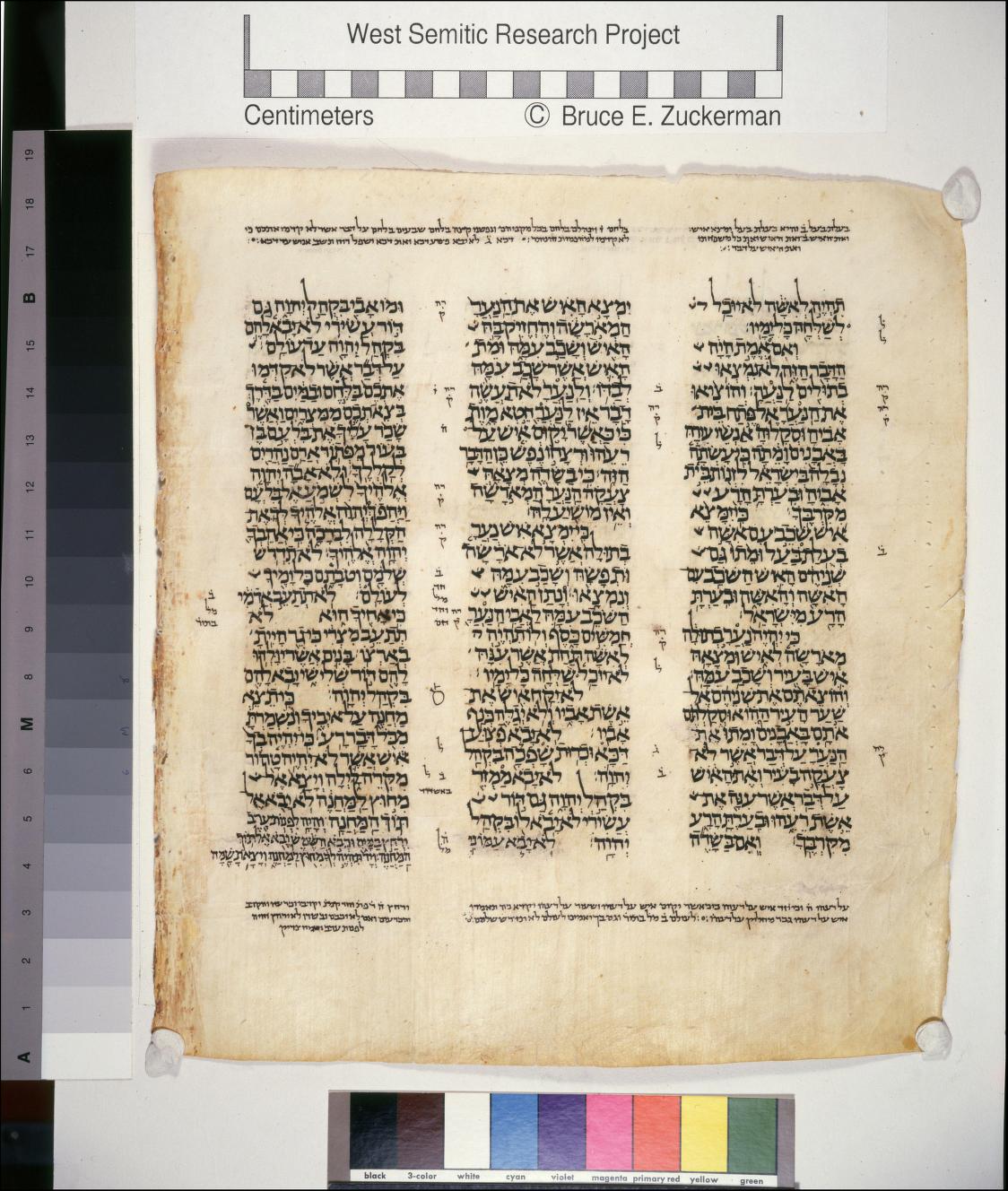
The Masoretes were a Rabbinic scribal school, primarily in Tiberias and Babylonia, who preserved the Hebrew Scriptures through a copying process renowned for meticulous integrity.
In this folio, the leaf contains Masorah Parva (tiny notes between columns), Masorah Magna (long notes in the top and bottom margins), tight column structure, clear vowel points, vocalization and cantillation marks, and marginal statistical notes. It preserves Deuteronomy 31:24-26, explicitly about writing, completion, and preservation of the Torah.
“When Moses had finished writing the words of this law in a book to the very end, Moses commanded the Levites who carried the ark of the covenant of the LORD, ‘Take this Book of the Law and put it by the side of the ark of the covenant of the LORD your God, that it may be there for a witness against you.’”
The zenith of textual fidelity, the Masoretic sedulosity developed from the ancient presbyterial system, its strict transmission rules passed down as a sacred custody of ecclesial records and covenantal memory.
And that was in the 6th to 10th centuries — the technology on hand was scribes and parchment.
image: National Library of Russia, St. Petersburg (https://archive.org/details/Leningrad_Codex_Color_Images/page/n223/mode/1up)
“The minimum essential officers for the conduct of business in a deliberative assembly are a presiding officer, who conducts the meeting and sees that the rules are observed, and a secretary, or clerk, who makes a written record of what is done—usually called ‘the minutes’. …
If the existence of an error or material omission in the minutes becomes reasonably established after their approval—even many years later—the minutes can then be corrected … In such a case the content of the original minutes must not be altered …”
— Robert’s Rules of Order Newly Revised, §3, §48 (RONR (12th ed.) 3:6, 48:15)
“Rules. Without them, we live with the animals.”
— Winston Scott, The Manager, New York Continental Hotel
ATLANTA, GA — As the platitude often goes, “The devil is in the details,” but God was in the details long before anyone. Some aspects of church life that may be thought pedantic, such as polity, actually require careful, steady precision in order to protect the gospel, the flock, and its undershepherds — and to prevent ostensibly negligible problems from turning pastures into mountains.
So, underlying very visible institutional drama often can be a less-visible amalgam of relatively small administrative lapses.
Accurate minutes and records are foundational to judicial review, Constitutional accountability, and the orderly government of the Church. Thus, the General Assembly, the highest Court of the Presbyterian Church in America (PCA), requires all presbyteries to maintain comprehensive records of licensure, examination, ordination, and ministerial actions. The Committee on Review of Presbytery Records (RPR) reviews these submissions annually, citing “exceptions of form” or “exceptions of substance” when presbyteries fail to comply. In advance of the annual General Assembly, each presbytery has the opportunity to respond to such exceptions for the official minutes. Certainly, many presbyteries historically have been subject to such exceptions and Citations. The Central Florida Presbytery (CFP), however, has repeatedly fallen short, failing to receive a clean audit in 42 out of 46 official reviews since 1978 — 91.3 percent over 48 years — and has been formally Cited at least thrice. This systematic pattern across nearly half a century raises governance concerns about accountability and protection for both congregations and individuals.
When queried through official channels to clarify specific questions about this history, especially arising from the most recent General Assembly in 2025, Central Florida Presbytery through its Stated Clerk declined to comment.
As for the preceding 46-year audit trail, it is all public record, as Presbytery already had opportunities every year to respond to General Assembly’s exceptions to its records — in the GA minutes themselves, since 1978, Presbytery’s first year subject to review and control.
“R. C. took his message to the people because that’s what the Reformers did.
… Luther took the message to the people.”
— R. C. Sproul: A Life, Stephen J. Nichols, pp. 286-287
1. Constitutional and Procedural Context
The Presbyterian Church in America has primary standards: the Holy Scriptures; secondary standards, the Westminster Confession of Faith and Catechisms, as well as The Book of Church Order, which together comprise the PCA Constitution; and tertiary standards, such as the current edition of Robert’s Rules of Order Newly Revised. A particular presbytery or session may have tertiary standards for itself such as standing rules, but the BCO belongs to the General Assembly which requires its adherence by those subordinate courts.
According to the Rules of Assembly Operations,
ARTICLE XVI. REVIEW OF PRESBYTERY RECORDS
16-1. It is the right and duty of the General Assembly to review, at least once a year, the records of the presbyteries of the Presbyterian Church in America (BCO 40-1 and 2).
16-2. General Assembly carries out this review through its Committee on Review of Presbytery Records.
According to The Book of Church Order,
13-9. The Presbytery has power to receive and issue appeals, complaints, and references brought before it in an orderly manner. In cases in which the Session cannot exercise its authority, it shall have power to assume original jurisdiction. It has power:
a. To receive under its care candidates for the ministry; to examine and license candidates for the holy ministry; to receive, dismiss, ordain, install, remove and judge ministers;
b. To review the records of church Sessions, redress whatever they may have done contrary to order and take effectual care that they observe the Constitution of the Church;
c. To establish the pastoral relation and to dissolve it at the request of one or both of the parties, or where the interest of religion imperatively demands it;
d. To set apart evangelists to their proper work; to require ministers to devote themselves diligently to their sacred calling and to censure the delinquent;
e. To see that the lawful injunctions of the higher courts are obeyed;
f. To condemn erroneous opinions which injure the purity or peace of the Church; to visit churches for the purpose of inquiring into and redressing the evils that may have arisen in them; to unite or divide churches, at the request of the members thereof …
40-1. It is the right and duty of every court above the Session to review, at least once a year, the records of the court next below, and if any lower court fails to present its records for this purpose, the higher court may require them to be produced immediately, or at any time fixed by this higher court.
40-2. In reviewing records of a lower court the higher court is to examine:
1. Whether the proceedings have been correctly recorded;
2. Whether they have been regular and in accordance with the Constitution;
3. Whether they have been wise, equitable and suited to promote the welfare of the Church;
4. Whether the lawful injunctions of the higher court have been obeyed.
Various failures to adhere to these standards have been documented in GA records from 1978 through 2024.
2. Condensed Timeline of Key Citations (1978–2024)
A review of 46 completed annual audits of Central Florida Presbytery’s records reveals a long-running cadence of substantive deficiencies spanning nearly the entire life of the Court. While the specific issues vary by year, the historical record shows recurring problems in the accurate documentation of ministerial actions, judicial procedures, and Constitutional compliance. Over time, these deficiencies intersected with several high-profile developments, including the schismatic formation of local churches that were founded by PCA officers but were operating outside the ordinary purview of denominational accountability. Specifically, these administrative trends formed the primordial context during the period in which Saint Andrew’s Chapel was spawned.
1978–1986: Foundational Deficiencies Emerge
From its first audit in 1978, the General Assembly identified omissions in Central Florida’s minutes, cataloguing incomplete documentation of examinations, ministerial status, and procedural actions. Throughout the early 1980s, exceptions repeatedly cited missing rolls, absent standing rules, incomplete ordination records, and failures to record required Constitutional elements.
Although several years reflected satisfactory corrections, the pattern established early: core Presbytery functions were often performed without a complete or verifiable written record.
1987–1994: Escalation and First Supervisory Pressure
By the late 1980s, deficiencies expanded to include failure to submit minutes, lack of responses to prior exceptions, and incomplete reporting of session oversight. In 1989, the General Assembly formally cited Central Florida for delinquency after a backlog of unaddressed deficiencies.
The early 1990s continued to reflect exceptions of substance affecting ministerial licensure, ordination processes, judicial procedure, and congregational actions. During this period, the Standing Judicial Commission also reversed Presbytery actions in at least one case for procedural irregularities.
The issues identified were no longer merely clerical; they affected the documented integrity of the Presbytery’s Constitutional processes.
1995–2001: Persistent Examination and Oversight Gaps
Throughout the late 1990s, the General Assembly repeatedly uncovered incomplete records of licensure and ordination examinations, missing elements of required votes, and lack of documentation for Presbytery review of sessional records.
This period also coincided with developments that would later prove significant for denominational oversight.
In October 1997, Central Florida Presbytery approved a request by Teaching Elder R.C. Sproul to labor out of bounds in connection with what became Saint Andrew’s Chapel — an independent congregation from conception whose pastors retained PCA credentials while the church itself remained outside denominational jurisdiction.
Subsequent General Assembly reviews (1998–1999) again found Central Florida delinquent for incomplete records related to examinations and ministerial oversight, including deficiencies associated with the same stated meeting at which Sproul’s the out-of-bounds approval occurred.
While the Assembly did not directly challenge the decision itself, the contemporaneous audit findings reflected the same ongoing pattern: significant ministerial actions were not fully documented in the official record.
2002–2011: Structural Concerns and Judicial Consequences
The first decade of the new millennium brought continued exceptions of substance, including:
- incomplete or missing examination records
- absent congregational actions required by the general principles of biblical polity
- failure to document judicial-commission proceedings
- lack of clarity and needfulness regarding out-of-bounds ministries
In several years, the General Assembly found Central Florida’s responses to prior exceptions unsatisfactory.
By 2009–2011, the pattern resulted in additional supervisory pressure, including direction for the Presbytery to appear before the Standing Judicial Commission for failures related to record submission and compliance.
2012–2019: Continuing Administrative Instability
The following years reflected ongoing deficiencies in executive session records, oversight of teaching elders laboring outside local congregations, and documentation of judicial and administrative actions.
The persistence of similar exceptions across decades suggested that earlier corrective efforts had not produced durable administrative reform.
2020–2024: Procedural Reversals and Ongoing Exceptions
Recent years have combined continued audit deficiencies with significant judicial consequences. The Standing Judicial Commission overturned or remanded Presbytery actions in multiple cases, emending procedural errors and failures to follow required standards.
At the same time, the Committee on Review of Presbytery Records continued to identify substantive deficiencies, including incomplete documentation of judicial commissions, out-of-bounds oversight, and required Constitutional actions.
Summary of the Pattern
Across four and a half decades, the historical record reflects:
- repeated exceptions affecting core poimenical and judicial functions
- multiple periods of supervisory intervention by the General Assembly
- documented procedural reversals by the Standing Judicial Commission
- recurring deficiencies in the recording of major ministerial actions, including oversight of out-of-bounds calls
The development of Saint Andrew’s Chapel — an unpresbyterated congregation served by Presbytery-credentialed ministers — did not occur in isolation. It arose during a period in which the General Assembly was already identifying significant gaps in Central Florida Presbytery’s documentation of examinations, ministerial status, and Constitutional compliance.
The audit record does not attribute intent. It does, however, establish a consistent administrative environment in which major decisions were sometimes made without the level of written clarity and procedural documentation required for effective denominational review and accountability.
3. Implications
The historical pattern indicates systemic deviation from Presbyterian standards that threatens both procedural integrity and member rights, possibly also striking at the vitals of religion. Persistent recordkeeping failures impact:
- Congregational oversight: Members may be unaware of pastoral actions, votes, or disciplinary measures affecting their churches.
- Ministerial accountability: Teaching elders laboring “out-of-bounds” risk ministerial misuse without clear presbytery review.
- Judicial fairness: Recurrent procedural missteps in disciplinary cases have already required SJC intervention.
The cache of errors and omissions in this audit trail, drawn from GA minutes and PCA Constitutional provisions, illustrates the prolonged struggle of Central Florida Presbytery to meet its obligations under Church law. Congregants, pastors, and denominational authorities appear to continue grappling with the fallout from decades of administrative dereliction.
5. Parameters and Methodology
At least a few qualifications are important to keep in mind with this data.
For purposes of this analysis, every year of General Assembly minutes from 1978 through 2024 was manually reviewed. Central Florida Presbytery was formed in 1977 so its first year’s audit was not adopted until the following General Assembly. In 48 years of existence, Central Florida Presbytery has had 46 completed annual audits. The 2025 audit appears complete as of the time of publication, but not official until the 2026 General Assembly adopts the findings. So technically, there have been 46 official annual audits in 48 years of the Presbytery’s existence. The percentage reflects the proportion of years in which the Committee on Review of Presbytery Records reported at least one exception related to recordkeeping: 42 years with exceptions divided by 46 total annual audits equals 91.3 percent. Or, a ratio of 9:10.
The General Assembly notes basically two types exceptions, those of form and those of substance. For the purposes of this analysis (and basic charity), exceptions of form are generally discounted and only exceptions of substance are counted. Where the GA did not explicitly classify an exception as form or substance, classification was based on whether the deficiency affected Constitutional compliance or judicial procedure. The reported exceptions varied in severity but consistently reflected deficiencies in required recordkeeping practices.
The years in which such substantive exceptions became part of the permanent record total forty-two (42): 1978, 1980, 1981, 1983, 1984, 1985, 1987, 1988, 1989, 1990, 1991, 1992, 1993, 1995, 1996, 1997, 1998, 1999, 2000, 2002, 2003, 2004, 2005, 2006, 2007, 2008, 2009, 2010, 2011, 2012, 2013, 2014, 2015, 2016, 2017, 2018, 2019, 2020, 2021, 2022, 2023, and 2024. The only years when the GA approved Presbytery’s minutes without exception were 1979, 1982, 1986, 1994, and 2001.
Case names are standardized to “v.” except where quoted directly from official records.
The word “cite” is used with various meanings, such as to identify an error or omission; to mention or refer to a statute; or to officially/authoritatively summon a lower court to appear before a higher court. Not every finding of error over the years is subject to formal Citation with a majuscule C. For clarity, occurrences of a supervisory action of Citation are capitalized herewith.
Though the GA Committee on Review of Presbytery Records has located errors and omissions in Central Florida’s journal, of course the GA itself possibly can err in its auditing practices, for “All synods or councils since the apostles’ times, whether general or particular, may err, and many have erred; therefore they are not to be made the rule of faith or practice, but to be used as a help in both.” (Westminster Confession of Faith 31.4)
This report analyzes patterns in the public record. It does not attempt to assess motive, assign intent, or draw conclusions beyond what the documented actions and official findings support.
6. Detailed Timeline
Most of the following facts are easily accessible at The PCA Historical Center, which should equip the reader to discern if Central Florida Presbytery has been adequately fulfilling its responsibility — and if not, what may be the implications upon church members currently or formerly under its authority.
Certain appurtenant events in the background are recounted between official GA audits.
12/04-07/1973: The inaugural General Assembly of the National Presbyterian Church, later renamed the Presbyterian Church in America, accepts the recommendation of the Committee on Inter Church Relations to adopt a promulgation which asserts its “intensely Presbyterian” convictions:
“A MESSAGE TO ALL CHURCHES OF JESUS CHRIST THROUGHOUT THE WORLD FROM THE GENERAL ASSEMBLY OF THE NATIONAL PRESBYTERIAN CHURCH
Greeting: Grace, Mercy and Peace be multiplied upon you! As the National Presbyterian Church takes her place among the family of Churches of the Lord Jesus Christ, we take this opportunity to address all Churches by way of a testimony. We gather as a true branch of the Church of our Lord Jesus Christ. We affirm our allegiance to Him as the sole Head of the Church and the sole Law-giver in Zion. We remember that ‘the gates of hell shall not prevail’ against His Church. The constituency of this new denomination for the most part have separated themselves from the Presbyterian Church in the United States. The decision to separate has come only after long years of struggle and heartache on the part of many of us to return the Church to purity of faith and practice. Principle and conviction entered into that decision, reached only after much soul searching and earnest prayer. We have reluctantly accepted the necessity of separation, deeming loyalty to Christ to take precedence over relationship to any earthly institution, even to a visible branch of the Church of Christ. In much prayer and with great sorrow and mourning we have concluded that to practice the principle of purity in the Church visible, we must pay the price of separation. We desire to elaborate upon those principles and convictions that have brought us to that decision.
We are convinced that our former denomination as a whole, and in its leadership, no longer holds those views regarding the nature and mission of the Church, which we accept as both true and essential. When we judged that there was no human remedy for this situation, and in the absence of evidence that God would intervene, we were compelled to raise a new banner bearing the historic, Scriptural faith of our forefathers. …
We have called ourselves ‘Continuing’ Presbyterians because we seek to continue the faith of the founding fathers of that Church. Deviations in doctrine and practice from historic Presbyterian positions as evident in the Presbyterian Church in the United States, result from accepting other sources of authority, and from making them coordinate or superior to the divine Word. …
Change in the Presbyterian Church in the United States came as a gradual thing, and its ascendancy in the denomination, over a long period of time. We confess that it should not have been permitted. Views and practices that undermine and supplant the system of doctrine or policy of a confessional Church ought never to be tolerated. A Church that will not exercise discipline will not long be able to maintain pure doctrine or godly practice.
When a denomination will not exercise discipline and its courts have become heterodox or disposed to tolerate error, the minority finds itself in the anomalous position of being submissive to a tolerant and erring majority. In order to proclaim the truth and to practice the discipline which they believe obedience to Christ requires, it then becomes necessary for them to separate. This is the exercise of discipline in reverse. It is how we view our separation. …
We declare also that we believe the system of doctrine found in God’s Word to be the system known as the Reformed Faith. We are committed without reservation to the Reformed Faith as set forth in the Westminster Confession and Catechisms. It is our conviction that the Reformed faith is not sectarian, but an authentic and valid expression of Biblical Christianity. We believe it is our duty to seek fellowship and unity with all who profess this faith. We particularly wish to labor with other Christians committed to this theology.
We further renew and reaffirm our understanding of the nature and mission of the Church. We have declared that Christ is King and only Law-giver in Zion. He has established the Church. His Church is a spiritual reality. As such it is made up o f all the elect from all ages. This spiritual entity is manifested visibly upon the earth. The Church visible is found wherever there are those who profess the true faith together with their children. As an assembly of those who do so profess this faith, we have established this denomination in the belief that it is a true branch of the Christian Church. We believe the Church in its visible aspect is still essentially a spiritual organism. As such, its authority, motivation and power come from Christ, the Head, who is seated at the right hand of God. He has given us His rule-book for the Church, namely, the Word of God written. We understand the task of the Church to be primarily declarative and ministerial, not legislative or magisterial. It is our duty to set forth what He has given us in His Word and not to devise our own message or legislate our own laws. …
As a Church, we consciously seek to return to the historic Presbyterian view of Church government. We reaffirm in the words of that earlier ‘Address to All Churches’ the following:
‘The only thing that will be at all peculiar to us is the manner in which we shall attempt to discharge our duty. In almost every department of labor, except the pastoral care of congregations, it has been usual for the Church to resort to societies more or less closely connected with itself, and yet logically and really distinct. It is our purpose to rely upon the regular organs of our government, and executive agencies directly and immediately responsible to them. We wish to make the Church, not merely a superintendent, but an agent. We wish to develop the idea that the congregation of believers, as visibly organized is the very society or corporation which is divinely called to do the work of the Lord. We shall, therefore, endeavor to do what has never been adequately done — bring out the energies of our Presbyterian system of government. From the session to the Assembly, we shall strive to enlist all our courts, as courts, in every department of Christian effort. We are not ashamed to confess that we are intensely Presbyterian. We embrace all other denominations in the arms of Christian fellowship and love, but our own scheme of government we humbly believe to be according to the pattern shown in the Mount, and, by God’s grace, we propose to put its efficiency to the test.’
As this new member of the family of Churches of the Lord Jesus Christ comes into being, we necessarily profess the Biblical doctrine of the unity of all who are in Christ. We know that what happens in one portion of His Church affects all of the Body of Christ. We covet the prayers of all Christians that we may witness and serve responsibly. We desire to pursue peace and charity with love towards fellow Christians throughout the world. …
We greet all believers in an affirmation of the bonds of Christian brotherhood. We invite into ecclesiastical fellowship all who maintain our principles of faith and order.
We now commend ourselves to God and the Word of His power. We devoutly pray that the Church catholic may be filled afresh with the Holy Spirit, and that she may speedily be stirred up to take no rest until the Lord accomplishes His Kingdom, making Zion a praise in the whole earth.
December 7, 1973”
(Minutes of the First General Assembly of the National Presbyterian Church, pp. 40-42)
09/13-17/1976: The quadrennial PCA General Assembly adopts a judgment arising from the Complaint of the Trinity Church (Slidell, LA) v. Grace Presbytery, which verdict resolves that “the Book of Church Order does not envisage the ordination of a candidate expressly to pastoral services in a church of another denomination.”
(Minutes of the Fourth General Assembly of the Presbyterian Church in America, p. 70)
09/16/1977: Upon its Resolution to affiliate with the Presbyterian Church in America, the Central Florida Presbytery commits to follow Presbyterian principles and abide by the PCA Constitution.
“BE IT RESOLVED that the PRESBYTERY OF CENTRAL FLORIDA, which is composed of the following Churches and Ministers, who all concur with and subscribe to the Constitution of the Presbyterian Church in America (A Corporation), namely, the Westminster Confession of Faith, the Larger and Shorter Catechisms, and the Book of Church Order, as the basis for church unity, does here declare its commitment to the Presbyterian Church in America as that branch of the Church of Christ to which it adheres; …
BE IT FURTHER RESOLVED that pursuant to the above Resolution, the Presbytery of Central Florida does hereby request formal recognition of it by the Fifth General Assembly of the Presbyterian Church in America as a member Presbytery of the Presbyterian Church in America (A Corporation), with all the rights and obligations belonging to member presbyteries as set forth in the Book of Church Order of the Presbyterian Church in America. The Presbytery of Central Florida reserves to itself the right to withdraw from said Assembly at any time under conditions and in accordance with such rules as may be prescribed by the Presbytery. … Whereas the Book of Church Order of the Presbyterian Church in America sets forth a scriptural formulary for church organization; and
Whereas the statement, ‘Rights of Particular Churches in Relation to the Denomination and Its Courts’ is adopted by us as setting forth principles of Presbyterian government essential to our agreement …”
The quinquennial PCA General Assembly adopts the Resolution of Formation, “thus constituting the Presbytery of Central Florida as a Presbytery of the Presbyterian Church in America.”
06/19-23/1978: The sexennial PCA General Assembly recommends the nascent Central Florida Presbytery’s minutes “for approval with exception.” Among the omissions, “full information needed on boundaries not included” and a minister “was received without examination. The Assembly ordered that Central Florida Presbytery either show in its Minutes that Mr. Porter has been examined, or proceed to examine him.” Additionally, the “substance of complaint of Mrs. Jocelyn Elkes against Central Florida is not included in the Minutes. The Committee recommends that General Assembly bring to the attention of Central Florida Presbytery that for clarity the substance of complaints should be placed in the Minutes. Adopted.”
06/18-22/1979: The septennial PCA General Assembly approves Central Florida Presbytery’s minutes “without exception but with notation.” An improvement then obtains in the Disposition for “Central Florida — Exceptions noted in Sixth General Assembly minutes were corrected.” So the previous year’s journal was clarified, but the omissions nonetheless were found when audited; and according to Robert’s Rules of Order, “the minutes can then be corrected” but “In such a case the content of the original minutes must not be altered, although it may be advisable for the secretary to make a marginal notation indicating the corrected text or referring to the minutes of the meeting at which the correction was adopted.” (RONR (12th ed.) 48:15)
As presbyteries always have opportunities to respond to supervisory exceptions for the next General Assembly, either agreeing or disagreeing, such corrections recur several times over the years.
06/16-20/1980: The octennial PCA General Assembly approves Central Florida Presbytery’s minutes “with exception [unspecified type].” The multiple exceptions include missing statement of an established quorum, unapproved minutes, and “exception — No roll of presbytery appears, no copy of standing rules appears.” These are not exceptions of form, so by deduction they are exceptions of substance.
06/15-19/1981: The novennial PCA General Assembly approves Central Florida Presbytery’s minutes “with exception [unspecified type].” “Central Florida – No directory of Presbytery — No roll of Presbytery — No list of candidates or licentiates — No up-to-date copy of the Standing Rules — No guidelines for keeping Presbytery minutes.” Once again, by inference these must be, to use RONR’s term, “material omissions.”
Additionally, “Presbyteries responding inadequately: … 4. Central Florida: Standing rules and roll and directory of still omitted; Minutes approval still omitted” is reported.
06/14-18/1982: The decennial PCA General Assembly adopts the Recommendation to accept Central Florida Presbytery’s “satisfactory corrections” to the exceptions “cited” the prior year.
06/13-17/1983: The undecennial PCA General Assembly approves Central Florida Presbytery’s minutes “with exceptions [unspecified type].” They include, “Commissions must have the quorum established by the presbytery at the time of appointment … No record of new presbyters being received nor of their signing of Ministerial obligation. … A man cannot simply be ‘enrolled’ in presbytery … Permission is granted to a Mission church pastor not one ordained as an evangelist (BCO 8-6).” As the minutes had earlier enumerated the “notations,” these as well are substantive exceptions.
06/18-22/1984: The duodecennial PCA General Assembly approves Central Florida Presbytery’s minutes “with the exceptions noted— … Error in procedure in a suspension. A suspension should not be retroactive to a prior date, but takes effect from the date of presbytery action. … Minutes show a man called to one presbytery, but examined by another presbytery.”
Additionally, the GA approves the Presbytery’s “responses to the exceptions taken by the Eleventh General Assembly as being satisfactory.”
06/17-21/1985: The tredecennial PCA General Assembly approves Central Florida Presbytery’s minutes “with the exceptions stated:
… Pastoral calls are not printed (25-17-B-lb, etc.).
… Pastoral call not printed (or acted on) (26-13-B-2).
… Need to specify vote tallies (25-7-F1; RAO 9-14-6B).
… TE improperly elected moderator contrary to Presbytery rules (3-1).
… Details of exams need to be listed, showing fulfillment of BCO 18-19 and 21 (27-12B-3).
… Use of title ‘Rev .’ (100-85) (see BCO 7-2/M12GA, 12-97, IV, 1.b., p. 208).
… Name of one closing in prayer omitted (10A-85). See RAO 9-14-4.a.
… Improper Commission report (32C-84): names omitted.”
Additionally, the GA approves the Presbytery’s “responses to the exceptions taken by the Twelfth General Assembly (and prior Assemblies where not previously dealt with).”
06/23-27/1986: The quattuordecennial PCA General Assembly approves Central Florida Presbytery’s minutes “without exceptions.”
06/15-19/1987: The quindecennial PCA General Assembly approves Central Florida Presbytery’s minutes “with the exceptions stated:
… the name of the person opening in prayer should be recorded. (RAO 9-14-4a)
… No indication that candidates Malloy & Lamb were endorsed by their session. (BCO 18-2)
… The minutes do not record that the necessary 2/3 majority was obtained to rescind a previously adopted motion. (RRO 34)
… specific exceptions to session records and churches not listed. (BCO 40-3)
… the name of the person opening in prayer should be recorded (RAO 9-14-4a).
… no indication that candidate Eckenwiler was endorsed by his session (BCO 18-2)
… The petitioners must nominate candidates for ruling elder from the list of men presbytery approves at least 30 days prior to the election and organization service (BCO 5-9-3).
-CM & MHW no indication candidate Ted Strawbridge was endorsed by his session (BCO 18-2)
… resolutions committee appointed; no report in minutes.
… MHW report – TE Corzine: no questions of ordination asked (BCO 13-6).
… ‘Exceptions’ to session minutes should be specified in their particulars in presbytery’s minutes (BCO 40-3).”
06/06-10/1988: The quindecennial PCA General Assembly approves Central Florida Presbytery’s minutes “with the exceptions stated” which is a verbatim list carrying forward the same exceptions from the preceding year, as well as new, unspecified “exceptions of substance.”
Additionally, this Presbytery was “not represented due to non-appointment or appointees not responding.”
(M16GA, pp. 150-151, 229, 250)
06/15-20/1989: The septendecennial PCA General Assembly did not approve nor find exceptions to Central Florida Presbytery because it notes that the Court did not submit minutes at all. The “Roll of Review & Control” notes that Presbytery’s appointed representative “did not report.”
Additionally, the GA adopts the motion to “Recommend that the 17th GA cite the following presbyteries’ for failing to submit responses to the exceptions taken by the 15th GA and direct them to respond at their next Stated meeting.” After a backlog of delinquencies, this appears to be Presbytery’s first formal Citation.
06/11-15/1990: The octodecennial PCA General Assembly approves Central Florida Presbytery’s minutes “with exceptions of substance
… Licentiate from another presbytery not examined according to BCO 19-5.
… Education credentials/internship: approval of internship omitted (BCO 21-4).
… No evidence of congregational concurrence in the dissolution of pastoral relationship (BCO 23-1).
… Only one set of Minutes from 1989 was received for review. Standing rules require four stated meetings per year and BCO 13-11 requires Presbytery to meet at least twice per year.”
06/17-20/1991: The novendecennial PCA General Assembly further establishes a pattern of constitutional errors, oversights and incomplete records in requirements for Central Florida Presbytery’s licensure, examination, installation and ordination process for teaching elders and a ruling elder, as well as no directory, no roll, no list of candidates nor licentiates, and no standing rules. In its report, the GA Committee on Review of Presbytery Records approves Central Florida Presbytery’s records, with “exceptions of substance.”
This year, the GA begins regularly invoking the specific statutes affected; herewith, where the GA specifies its own exceptions, “Alleged violations (errors and/or delinquencies)” are listed before links to the GA minutes.
Alleged violations (errors and/or delinquencies): BCO 13-11; 40-1,-2,-4; RAO 16-3,-4.c
06/19/1991: The Standing Judicial Commission asseverates the PCA’s fundamental principle of “voluntary association,” because its historical background as a 1973 departure from the mainline Presbyterian Church in the United States underlies the very origin/existence of the denomination.
“MINUTES – WEDNESDAY AFTERNOON
June 19, 1991
Fifth Session
19-48 Standing Judicial Commission …
REPLY TO GENERAL ASSEMBLY ON JOHN M. WARREN, JR. MEMORIAL
I. STATEMENT OF THE ISSUES
The Standing Judicial Commission files this Report and Recommendation with the 19th General Assembly on the Memorial from TE John M. Warren, Jr. seeking clarification of the effects of the action of the 17th G.A. as it affects the action of the 16th G.A. relating to the Carl Fox matter. …
PCA is a voluntary association of people committed to a common faith and order. The BCO § 25-11 explicitly expresses this voluntary principle as it applies to the association of a local church with the denomination:
25-11: ‘… Particular churches need to remain in association with any court of this body only so long as they themselves so desire. The relationship is voluntary, based upon mutual love and confidence, and is in no sense to be maintained by the exercise of any force or coercion whatsoever. A particular church may withdraw from any court of this body at any time for reason which seem to it sufficient.’
We believe this same voluntary principle applies to an individual’s association with a local PCA congregation.
…
STANDING JUDICIAL COMMISSION
A. PRESENT PERSONNEL:
Class of 1994 …
Ruling Elder
John B. White, Jr., N. Georgia”
(M19GA, pp. 91, 96-97, 104, 462)
06/15-18/1992: The vigintennial PCA General Assembly approves Central Florida Presbytery’s minutes “with exceptions of substance,” including no record of membership transfer, and of the moderator having asked required questions.
Additionally, the GA adopts the motion that the Presbytery’s “response to the exceptions of the 19th General Assembly be approved as satisfactory.”
Also this year, Presbytery has a judicial loss, Case 91-5. The Standing Judicial Commission reports,
“We will demonstrate that the action of Central Florida Presbytery (through its commission and approved by the court) was:
1. To allow improper and new evidence to be introduced into the hearing, i.e. the character of the complainants.
2. That these aspersions upon the character were made against one of the complainants, not both, yet both were denied.
3. That the Session had previously approved both men in character as a part of their exams for ordination, and had taken no disciplinary or administrative action to deal with either man on matters of ‘conduct’.
4. That the decision of the Presbytery is improper in that the declaration that “theonomy is out of accord’ with the WCF and is to be annulled was on the basis that there was ‘insufficient clarity’ and in not sustaining the complaint.
We therefore assert that hearing of the complaint was improperly conducted, and that the complaint should have been sustained by the Presbytery.”
Alleged violations (errors and/or delinquencies): BCO 13-6; 19-3
06/07-11/1993: The 21st PCA General Assembly approves Central Florida Presbytery’s minutes “with exceptions of substance,” such that, “Permanent Committee Reports, B, MNA: There is no correspondence or explanation for the severance between the teaching elder and his church, nor is his subsequent status within presbytery defined. Also, “No response to the exceptions of the 20th GA was received.”
Alleged violations (errors and/or delinquencies): BCO 23-1
(M21GA, p. 230, emphasis original)
01/21/1994: Ruling Elder John White, of Westminster Presbyterian Church, authors the Reasoning and Opinion deciding the Complaint of Dr. and Mrs. Stuart S. Chen v. Ascension Presbytery (SJC 93-3), which continues the historical stream of SJC cases affirming the denomination’s own “voluntary association” principle.
“On April 26, 1992, Dr. Chen wrote a letter to the Session of the Church of the Savior in response to a suggestion by a Ruling Elder (ROC p. 51). In this letter he stated that he and his wife did not intend to return to the Church of the Savior; that he and his wife were looking for another church; and that they were worshipping at evangelical churches every Sunday; but they had not yet found a church home. He further stated in said letter:
‘Be assured that we believe that active and committed local church membership is very important. So important, in fact, that thorough study is needed before a commitment can responsibly be made. This means we will not rush to transfer our membership.’ (ROC p. 51)
Dr. Chen then concludes with this paragraph:
‘If this creates a problem for you regarding what to do with our membership status, please declare us inactive as spelled out in CSPCA [local church] Bylaws, or simply remove our names from the rolls.’ (ROC p. 51) (Emphasis added)
We conclude that this request of Dr. Chen is analogous to the resignation letter of Carl Fox. We further conclude that it certainly meets one of the conditions set out in BCO 46-5, i.e. ‘when a member … has made it known that he or she has no intention of fulfilling the church vows.’ But instead of granting Dr. Chen’s request to ‘simply remove our names from the rolls’, the Session of the Church of the Savior instituted judicial process against them and on December 5, 1992 suspended them from the sacraments. We think the Session should have followed BCO 46-5 which states that under this condition ‘then the Session should delete such names from the church rolls …’ … Respondents thus ignore the plain language of the BCO and the judicial interpretation thereof by the 18th General Assembly in the Carl Fox matter.
… PCA is a voluntary association of people committed to a common faith and order. The BCO 25-11 explicitly expresses this voluntary principle as it applies to the association of a local church with the denomination:
25-11: ‘… Particular churches need to remain in association with any court of this body only so long as they themselves so desire. The relationship is voluntary, based upon mutual love and confidence, and is in no sense to be maintained by the exercise of any force or coercion whatsoever. A particular church may withdraw from any court of this body at any time for reason which seem to it sufficient.’
We believe this same voluntary principle applies to an individual’s association with a local PCA congregation. …
In the light of the above, our Judgment of the case is that Respondents erred; and we reverse the judgment of the Session of the Church of the Savior and remove the censure of Stuart and Pam Chen in suspending them from the Sacraments.
We urge the Session of the Church of the Savior to grant the Chens a letter of dismissal to an evangelical church, if they have requested the same, or, if not, to delete their names from the rolls under BCO 46-5.
Heard on August 19, 1993 and signed this 21st day of January, 1994.
Respectfully submitted,
/s/RE John B. White, Jr.
/§/ TE John Montgomery
/s/ RE W. Jack Williamson”
06/06-10/1994: The 22nd PCA General Assembly approves Central Florida Presbytery’s minutes “without exception … And that their response to the exceptions of the 21st General Assembly be approved as satisfactory.”
The GA adopts the formal judgment in SJC 93-3.
06/19-23/1995: The 23rd PCA General Assembly approves Central Florida Presbytery’s minutes “with exceptions of substance,” which state, “Ruling Elders are not listed in report of Commission to organize a new church as well as to install and ordain elders and deacons,” and “By appointing a committee to further instruct a man whom it had just approved for ordination, the presbytery acknowledged that it was not fully satisfied with the individual’s qualifications for ordination (BCO 21-4).”
Alleged violations (errors and/or delinquencies): BCO 21-4
06/18-21/1996: The 24th PCA General Assembly approves Central Florida Presbytery’s minutes “with exceptions of substance,” including, “that exams for ordinations & transfer do not list all parts. (BCO 21-4), General: No record of required 3/4 vote for waiving internship requirements … Reference to an examination in previous meeting is not found in the minutes of the previous meeting.”
Alleged violations (errors and/or delinquencies): BCO 19-16, 21-4
1997 National Conference: PCA Teaching Elder R.C. Sproul publicly remarks, “I almost never hear the doctrines of grace proclaimed in my own church, in my own denomination. …
Am I crazy? Should I try to start a church and plant a church? …
I don’t know what I should do and I’m trying to sort that through, myself.”
(Essential Truths of the Christian Faith: 1997 National Conference, Questions and Answers #2, timestamp 39:58 through 44:53)
06/10-13/1997: The quadrancentennial PCA General Assembly identifies gaps in Central Florida Presbytery’s records for its licensure, examination and ordination process for teaching elders, as well as finds out-of-order waivers for internship requirements. In its report, the GA Committee on Review of Presbytery Records approves Central Florida Presbytery’s records, “with exceptions of substance.” Central Florida fails to respond to the GA with the records and explanations for its omissions.
Alleged violations (errors and/or delinquencies): BCO 13-11; 40-1,-2,-4; RAO 16-3,-4.c,-5,-10.b
07/11/1997: Saint Andrew’s Chapel, Inc., is formed.
(Saint Andrew’s Chapel Original Articles of Incorporation, 1997)
(Saint Andrew’s Chapel Original Bylaws, 1997)
07/20/1997:
“Appendix 2
R. C. SPROUL TIMELINE …
July 20, 1997. Holds first service of Saint Andrew’s Chapel in the Ligonier studios.”
(R. C. Sproul: A Life, Stephen J. Nichols, p. 327)
10/10/1997: Robert C. Cannada and W. Jack Williamson, ruling elders and founding fathers of the PCA, affirm the spirit of the courts’ and congregations’ voluntary association in BCO 25-11 as also appurtenant to emancipatory rights of individual members.
“The concept expressed in 25-11 of the BCO dealing with the relationship between a Presbytery and its members is also the concept applicable to the relationship between a congregation and its members and between the General Assembly and the presbyteries. This concept is expressed in 25-11 as follows:
‘Particular churches need remain in association with any court of this body only so long as they themselves so desire. The relationship is voluntary, based upon mutual love and confidence, and is in no sense to be maintained by the exercise of any force or coercion whatsoever.
A particular church may withdraw from any court of this body at any time for reasons which seem to it sufficient.’
Likewise, a member of a congregation may withdraw from membership or may be dismissed from membership by appropriate action of the session, and a presbytery may withdraw from the PCA or may be dismissed by the General Assembly. This is in accord with the concept contained in the eight basic principles as approved by the first General Assembly of the Presbyterian Church in America in 1789.”
(The Historic Polity of the PCA, p. 44; emphasis original)
The same authors later assert that a PCA church session, acting through its civil entity organized by state law, is subject to applicable civil laws of the state in the dismissal of members.
“Church courts should respect the decisions of other church courts. Lower church courts should comply with the applicable decisions of higher church courts subject to the ultimate guidance of the Scriptures and of Christian conscience. Each presbytery and each session has the power, acting through the civil entity that each has formed and organized, to dismiss members from its membership for such reason as it determines to be appropriate subject to the applicable civil laws of the State.”
(ibid., p. 78)
10/18/1997: At the Central Florida Presbytery 80th Stated Meeting, TE R.C. Sproul “asks” his ordaining authority to “let him” labor out of bounds at this independent church that “is being organized” in the north Orlando area, adding the pastoring of this church as a new responsibility to the out-of-bounds call that he already has at his parachurch ministry. Presbytery “approves” TE Sproul’s “request.” This event essentially is the genesis and the impetus which set in motion all the subsequent effects, for not one of them could have been possible without this aetiological event.
Apparent violations (errors and/or delinquencies)
Primary standards: Ecclesiastes 8:11, Acts 20:28, Hebrews 12:15
Secondary standards: WLC Q.99.6-8; BCO 3-3; 4-1; 5-9; 8-7 (cf. M4GA, Judicial Case 2); 13-5,-7; 14-7; 21-4.f,i,-5.2,3
“Who was R.C. Sproul?
Dr. R.C. Sproul (1939–2017) … was also the founding pastor of Saint Andrew’s Chapel in Sanford, Fla. …”
(www.ligonier.org/faqs/who-was-rc-sproul, (PDF, PNG))
“Church Planter
Some of this same [Renewing Your Mind recording studio] audience were regular visitors to the Sproul home for a Bible study. A group of families within that audience wanted to start a church. They approached R. C., wanting him to be a pastor. … The group persisted. …
R. C. became a church planter.
Saint Andrew’s Chapel first met in the [Ligonier Ministries] recording studio. R. C. called it a chapel because it was small. … Vesta explained why his name was chosen: ‘Andrew was always bringing people to Christ. That’s why we wanted to name it Saint Andrew’s.’ …
An undeveloped portion of the land would become the site of Saint Andrew’s Chapel … Two satellite buildings would also hold Ligonier staff. All that needed to be done now was to build a church building. …
The church sign says ‘Saint Andrew’s Chapel, A Reformed Congregation.’ A note on the church website explains:
Saint Andrew’s was founded in 1997 as an independent congregation in the Reformed tradition. As such, Saint Andrew’s is not affiliated with a particular denomination. That is not to say, however, that we are non-denominational or inter-denominational. On the contrary, Saint Andrew’s is an independent congregation on account of our desire to remain steadfast in the Reformed tradition without the influence of denominational governance. Nevertheless, our pastors are ordained ministers in the Presbyterian Church in America (PCA).
R. C. had his PCA ministerial credentials the entire time he pastored an independent church. It was not strictly his decision. The group that wanted to start the church and (kindly) cajoled R. C. into being their pastor met with representatives from the presbytery. That group felt that the representatives, at the time, were less interested in the confessional and doctrinal position of the church and more interested in its business plan and vision. This gave them pause. They reported back to R. C. In the end, they decided not to join the PCA but to remain independent. … The holy invades the profane in sacred space and sacred time. Saint Andrew’s Chapel, dedicated in 2009, is the manifestation of the vision laid out in the last chapter of the classic book from 1985 (The Holiness of God). …
In addition to Ligonier, R. C. founded two other institutions: Saint Andrew’s Chapel and Reformation Bible College. Saint Andrew’s Chapel faithfully continues the work started by R. C. Sproul and that small group of families. …
R. C. could look out his office window at Ligonier and see Saint Andrew’s Chapel to the left and Reformation Bible College to the right. He loved that. These were the institutions that God used R. C. to found—institutions that R. C. hoped would be faithful and, God willing, carry on in the service of the church, institutions that would proclaim, defend, and contend for the gospel. All three—Ligonier, Saint Andrew’s, and RBC—encircle a pond. …
In front of the large oaken doors under a Gothic arch at the entrance to Saint Andrew’s is a graveyard. R. C. always believed a church should have a graveyard. He thought it a strong object lesson for the congregation as they entered and left church. R. C. is buried in that graveyard.”
(R. C. Sproul: A Life, Stephen J. Nichols, pp. 219-224, 226, 304-305, 308)
06/30-07/03/1998: The 26th PCA General Assembly further uncovers a pattern of omissions, oversights and “lack of record” in requirements for all of the teaching elders in Central Florida Presbytery’s licensure, examination and ordination process — with specific mention of “exceptions of form” regarding the Presbytery stated meeting on October 18, 1997. In its report, the GA Committee on Review of Presbytery Records approves Central Florida Presbytery’s records, “with exceptions of substance.”
Presbytery rejoins, “We acknowledge the lack of record of the examination. A review of the notes does reflect the particulars of the exam. We will continue to make every effort to keep more accurate records than this incident reflects.”
After TE R.C. Sproul’s permission on October 18, 1997 to labor out of bounds at Saint Andrew’s, this appears to be an immediate warning sign from above that there are problems in Central Florida’s records.
Alleged violations (errors and/or delinquencies): BCO 13-11; 40-1,-4; RAO 16-3,-4.c,-5
06/15-17/1999: The 27th PCA General Assembly reiterates a pattern of omissions, oversights and incomplete records from the previous year in requirements for all of the teaching elders in Central Florida Presbytery’s licensure, examination and ordination process. In its report, the GA Committee on Review of Presbytery Records approves Central Florida Presbytery’s records, “with exceptions of substance.”
Presbytery acknowledges its omissions yet rebuffs its errors, “We assure GA that Presbytery is quite thorough in its examinations process and that parts of the exams were covered. Review of subsequent Minutes will reflect a more careful record in this area.”
Why are there so many gaps in Central Florida’s records for ordinations? The red flags continue.
Alleged violations (errors and/or delinquencies): BCO 13-11; 18-2; 40-1,-4; RAO 14-3.e.5,-6.c.2; 16-3,-4.c,-10
06/20-23/2000: The 28th PCA General Assembly notices, “Statement of exceptions by TE not included for review as Appendix A as indicated in the minutes.”
06/19-22/2001: The 29th PCA General Assembly approves Central Florida Presbytery’s minutes “without exception” and that “responses to the 28th GA exceptions be found satisfactory.” To start a fresh new millennium, Presbytery earns its last clean audit — but what does the next quarter-century have in store?
06/18-21/2002: The trigintennial PCA General Assembly approves Central Florida Presbytery’s records “with exceptions of substance,” including “Incomplete record of exam elements” and “No record of judicial commission executive session.”
Alleged violations (errors and/or delinquencies): BCO 21-4; RAO 14-3.e.5,6
06/10-13/2003: The 31st PCA General Assembly approves Central Florida Presbytery’s records “with exceptions of substance,” finding “No record of licensure candidate’s written or oral exam. … No record of signing ministerial obligation. … No record of review of sessional records.”
The GA also adopts that Presbytery’s “responses to the 30th GA exceptions be found satisfactory.”
Alleged violations (errors and/or delinquencies): BCO 13-7; 19-2; RAO 14-3.e.5
06/15-17/2004: The 32nd PCA General Assembly approves Central Florida Presbytery’s records “with exceptions of substance,” specifically, “Pages missing” and “No report of sessional minutes being reviewed. (This is a repeat finding).”
Alleged violations (errors and/or delinquencies): BCO 13-9.b; 13-11; 40-1; RAO 14-3.b
06/14-17/2005: The 33rd PCA General Assembly finds a continued pattern of errors, oversights and incomplete records in requirements for Central Florida Presbytery’s licensure, examination and ordination process for teaching elders, including, “No record of Session endorsement or PCA membership of candidate … Incomplete record of licensure exam requirements. … No record of call for a candidate for ordination. … No record of Session approval of change of call for Assistant Pastor and no record of new call. … Incomplete record of exam requirements for candidate being examined to become a TE.” In its report, the GA Committee on Review of Presbytery Records approves Central Florida Presbytery’s records, “with exceptions of substance.”
In retort, “Central Florida Presbytery reaffirms its previously stated commitment to fulfill its constitutional responsibilities where the review of Session Records is concerned, and expresses its appreciation to the General Assembly for its continued patience in this matter.”
Granted, 2004 was the year that Florida had several hurricanes, but this isn’t an isolated incident. What seems to be going on with Central Florida’s recordkeeping over a period of so many years?
Alleged violations (errors and/or delinquencies): BCO 13-11; 40-1,-4; RAO 16-3,-4.c,-5
06/20-23/2006: The 34th PCA General Assembly continues noticing a pattern of errors, oversights and incomplete records in requirements for Central Florida Presbytery’s licensure, examination and ordination process for teaching elders, especially with its out-of-bounds calls at non-PCA organizations. In its report, the GA Committee on Review of Presbytery Records approves Central Florida Presbytery’s records, “with exceptions of substance,” including, “No record of sessional endorsement or 6 month membership requirement for a candidate. … Incomplete record of ordination examination requirements. … No record of congregational meeting to dissolve pastoral relationship … No record of whether Presbytery considers out of bounds labors to be a valid Christian ministry. … No record of call for a candidate for ordination.”
Presbytery rebuffs that its records are complete and “The candidate was in fact fully vetted, and examined thoroughly as rightly required in our constitutional documents.” The Committee’s recommendation states “That the following responses to the 33rd GA exceptions be found unsatisfactory. The minutes should specifically record that each requirement has been met.”
Yet again, the highest Court cannot excuse the mistakes transpiring with Central Florida’s records.
Alleged violations (errors and/or delinquencies): BCO 13-11; 20-1; 21-1; 40-1,-2,-4; RAO 16-3,-4.c,-5,-10.b
10/30/2006: At its 119th Stated Meeting, the Central Florida Presbytery approves its Standing Rules which posit:
“APPENDIX:
POLICY REGARDING THE TRANSFER OF CREDENTIALED MEN FROM OTHER DENOMINATIONS AND INDEPENDENCY
Guiding principles for this policy:
*Recognition that the PCA is not the only legitimate expression of the Lord’s church
* Recognition that it is our duty as presbyters to preserve the purity of teaching and leadership within our churches.
* A desire for equitable treatment of candidates for presbytery membership
* Submission to the dictates of the BCO”
(Central Florida Presbytery Standing Rules, 2006)
02/2007: Burk Parsons writes in his article “Electing Elders” in 9Marks, “I have no disagreement over the importance and biblical precedent (i.e. Acts 6:3; 14:23) for the congregation’s role in confirming elders. Yet it is ultimately the responsibility of the elders to nominate and elect elders.”
(9News, February 2007, Volume 4, Issue 2, p. 19 or Electing Elders By Burk Parsons (PDF))
Apparent discordances with Parsons’ comments and his future Confessional Subscription
Primary standards: Psalm 94:20, Acts 6:1-7, 20:28, I Timothy 3:2,15, Titus 1:5-7, James 3:1
Secondary standards: BCO Preface II.6; 3-1; 7-3; 8-1,-2,-3; 13-5,-7; 16-2; 20-2,-3,-4,-5,-6,-7; 21-4.f,-5.2,3,4,7,8; 22-2; 24-1,-2,-3,-4,-5; 25-1,-7, 53-3
06/12-14/2007: The quintricennial PCA General Assembly continues noticing a pattern of errors, oversights and incomplete records in requirements for Central Florida Presbytery’s licensure, examination and ordination process for teaching elders, especially with its out-of-bounds calls at non-PCA organizations. In its report, the GA Committee on Review of Presbytery Records approves Central Florida Presbytery’s records, “with exceptions of substance.”
Presbytery of course responds, “We will make sure our committee reports, and minutes, reflect the required session endorsement, or PCA membership, of a candidate (BCO 18-2). … We will make sure that our minutes reflect that fact that all exam requirements have been met for both licensure and ordination.”
Evidently, libertine employment of the out-of-bounds provision, lax examinations and internship requirements, as well as disorganized recordkeeping, are longstanding troubles in Central Florida for many years. The proverbial handwriting has already been on the wall for a very long time.
Alleged violations (errors and/or delinquencies): BCO 13-11; 20-1; 21-1; 40-1,-4; RAO 16-3,-4.c,-5
06/10-12/2008: The 36th PCA General Assembly continues noticing gaps in records pertaining to specific licensure and examination requirements at Central Florida Presbytery, and the GA Committee on Review of Presbytery Records reports, “That as no responses to the 35th GA exceptions were received, these should be submitted to the 37th GA.”
Alleged violations (errors and/or delinquencies): BCO 13-11; 40-1,-2,-4; RAO 16-4.c,-5,-10.b
06/16-18/2009: The 37th PCA General Assembly Cites Central Florida Presbytery “to appear before the Standing Judicial Commission at its annual stated meeting with the stated records according to the provisions of RAO 16-4.e and BCO 40-1, 4 and 5 for repeatedly failing to submit minutes and/or responses to exceptions of substance,” and for gaps in records pertaining to specific licensure and examination requirements. The Report of the Committee on Thanks resolves, “Thank you to the saints from the Central Florida Presbytery for their diligence and hard work in making this a wonderful time of worship, teaching, and fellowship for the body of Christ.”
Yet, the GA Committee on Review of Presbytery Records concurrently has to report, “That as no responses to the 35th GA exceptions were received, these should be submitted to the 38th GA.” Despite the PCA thanking the host Presbytery’s hospitality for the General Assembly this year in Orlando, it still turns out to be a hot summer for Central Florida, whose perennial recordkeeping troubles and reporting derelictions have become clearly untenable from the GA’s vantage point.
Alleged violations (errors and/or delinquencies): BCO 13-11; 40-1,-4; RAO 16-3,-4.c,-5,-10.b
11/17/2009: TE Burk Parsons, having been already ordained by Saint Andrew’s Chapel, now is ordained in the PCA at the Central Florida Presbytery 132nd stated meeting, and is granted to labor out of bounds in a pastoral call where he already works, Saint Andrew’s. No pulpit committee, nor congregational nomination, nor vote precede this ordination. Parsons’ ordination contravenes the 1976 judicial precedent of the General Assembly that the BCO “does not envisage the ordination of a candidate expressly to pastoral services in a church of another denomination” (cf. BCO 14-7, M4GA, p. 70). So, Central Florida continues to clerically fertilize this prelatic habitat at Saint Andrew’s Chapel.
Apparent violations (errors and/or delinquencies)
Primary standards: Malachi 2:7, Acts 20:28, I Corinthians 1:10-11, I Timothy 5:22-25, James 1:22-25, 3:1,17-18
Secondary standards: WLC Q.99.6-8; BCO Preface I; 1-1; 3-3,-6; 4-1; 5-9; 7-3; 8-7 (cf. M4GA, Judicial Case 2); 11-4; 13-5,-7; 14-7; 18-1,-2,-4,-5,-8; 20-1,-2, 21-4.f,i,-7
Tertiary standards: Central Florida Presbytery, PCA, Exam Committee Vision, Values, Central Florida Presbytery Standing Rules, Candidacy Policy
06/29-07/02/2010: The 38th PCA General Assembly Cites Central Florida Presbytery a second time “to appear before the Standing Judicial Commission at its annual stated meeting with the stated records according to the provisions of RAO 16-4.e and BCO 40-1, 4 and 5 for repeatedly failing to submit minutes and/or responses to exceptions of substance,” and for gaps in records pertaining to specific licensure and examination requirements. The GA Committee on Review of Presbytery Records reports, “That as no responses to the 35th GA exceptions were received, these should be submitted to the 39th GA.”
Central Florida already had been Cited at the prior year’s GA pertaining to omissions in its licensure records from four years earlier, yet this Presbytery still fails to get its records in order.
Alleged violations (errors and/or delinquencies): BCO 13-11; 40-1,-4; RAO 16-3,-4.c,-5,-10.b
06/07-10/2011: The 39th PCA General Assembly enumerates a dozen dates in Central Florida Presbytery’s records with unresolved errors or gaps. In its report, the GA Committee on Review of Presbytery Records approves Central Florida Presbytery’s records, “with exceptions of substance.” The report states, “No record of review of sessional records … No response to the 38th GA or previous assemblies is required.”
It is unclear from the minutes what happened at this GA, since Presbytery had been Cited at the two previous consecutive years to answer the RPR Committee’s list of exceptions.
Alleged violations (errors and/or delinquencies) by the Central Florida Presbytery: BCO 13-11; 40-1,-4; RAO 16-3,-4.c,-5,-10.b
Apparent violations (errors and/or delinquencies) by the General Assembly: BCO 40-5; RAO 16-4.e,-6,-7,-10.c
08/23/2011: TE Kevin Struyk is ordained in the PCA and granted to labor out of bounds in a pastoral call at Saint Andrew’s, at the Central Florida Presbytery 139th stated meeting. No pulpit committee, nor congregational nomination, nor vote precede this ordination. This contravenes the 1976 judicial precedent of the highest Court of the Church, again (cf. BCO 14-7, M4GA, p. 70).
Apparent violations (errors and/or delinquencies)
Primary standards: Malachi 2:7, Acts 20:28, I Corinthians 1:10-11, I Timothy 5:22-25, James 1:22-25, 3:1,17-18
Secondary standards: WLC Q.99.6-8; BCO Preface I; 1-1; 3-3,-6; 4-1; 5-9; 7-3; 8-7 (cf. M4GA, Judicial Case 2); 11-4; 13-5,-7; 14-7; 18-1,-2,-4,-5,-8; 20-1,-2, 21-4.f,i,-7
Tertiary standards: Central Florida Presbytery, PCA, Exam Committee Vision, Values, Central Florida Presbytery Standing Rules, Candidacy Policy
06/19-21/2012: The quadragennial PCA General Assembly continues cataloging a pattern of errors, oversights and incomplete records in requirements for Central Florida Presbytery’s licensure, examination and ordination process for teaching elders, as well as minutes from executive sessions. In its report, the GA Committee on Review of Presbytery Records approves Central Florida Presbytery’s records, “with exceptions of substance.”
Central Florida responds, “Presbytery has been remiss in this area of its responsibility and will correct this situation by its next meeting in August. Our clerk has been unable to properly schedule the review, which is by our standing rules conducted by him for presbytery after its January meeting each year. This is important and it will be done correctly.”
One of the RPR Committee’s particular exceptions is, “Minutes of executive session not included.” This demonstrates that no presbytery has any authority to redact any portions — much less large swaths — of its executive session minutes in reports (nor a judicial record of a case) owed to the General Assembly, and thus it cannot feign privileged secrecy to only members of that presbytery.
Why does Central Florida continue to delay getting its records in order for the RPR Committee, after its recurring cunctations year over year resulting in the GA Citing Presbytery twice already?
Alleged violations (errors and/or delinquencies): BCO 13-11; 40-1,-2,-4; RAO 16-3,-4.c,-5,-10.b
06/18-20/2013: The 41st PCA General Assembly continues seeing a pattern of errors, oversights and incomplete records in requirements for Central Florida Presbytery’s licensure, examination and ordination process for teaching elders. In its report, the GA Committee on Review of Presbytery Records approves Central Florida Presbytery’s records, “with exceptions of substance.”
Central Florida responds, “Presbytery has been remiss in this area of its responsibility and will correct this situation by its next meeting in August. Our clerk has been unable to properly schedule the review, which is by our standing rules conducted by him for presbytery after its January meeting each year. This is important and it will be done correctly.”
This is verbatim, word-for-word, the very same excuse Presbytery gave the GA the previous year.
Yet again, Central Florida seems unfazed by the GA’s multiple citations of this Court after so many years of problematic recordkeeping, continuing to fail inspections of the orderliness of its records. It is not unfair to observe that this trend of deliberative disarray in Central Florida may be a proleptic recipe for the disorder that could fructify within its geographical jurisdiction in the coming years.
Alleged violations (errors and/or delinquencies): BCO 13-11; 40-1,-2,-4; RAO 16-3,-4.c,-5,-10.b
11/12/2013: TE Don Bailey, already ordained in the PCA, is granted to labor out of bounds in a pastoral call at Saint Andrew’s, at the Central Florida Presbytery 148th stated meeting. At this point and until Sproul’s passing in December 2017, Saint Andrew’s has four PCA-ordained teaching elders laboring out of bounds in regular superintendence of this unpresbyterated church (cf. BCO 14-7, M4GA, p. 70).
06/17-19/2014: The 42nd PCA General Assembly continues noticing a pattern of errors, oversights and incomplete records in requirements for Central Florida Presbytery’s licensure, examination and ordination process for teaching elders. In its report, the GA Committee on Review of Presbytery Records approves Central Florida Presbytery’s records, “with exceptions of substance.” Such exceptions include, “Minutes of executive session not included. … Incomplete record of licensure exam requirements. … No record of examination of TE transferring into Presbytery. … Incomplete ordination exam. … No commission formed to install TEs. … Request to be divested of office was acted upon at the same meeting. … Presbytery’s judgment of candidate’s stated differences with our Standards not recorded in the proper manner. …” and on and on.
Obviously, decades of Central Florida’s deficient recordkeeping carries on well into recent years, as it continues authorizing pastors to labor out of bounds into habitats without proper accountability.
Alleged violations (errors and/or delinquencies): BCO 5-9.i.2; 13-11; 15-2; 38-2; 40-1,-4; RAO 16-3,-4.c,-5,-10.b
06/09-11/2015: In connection with reported errors at the GA in 2014, the 43rd PCA General Assembly continues noticing a pattern of errors, oversights and incomplete records in requirements for Central Florida Presbytery’s licensure, examination and ordination process for teaching elders. In its report, the GA Committee on Review of Presbytery Records approves Central Florida Presbytery’s records, “with exceptions of substance.”
Alleged violations (errors and/or delinquencies): BCO 13-11; 40-1,-4; RAO 16-3,-4.c,-5,-10.b
12/06/2015: TE R.C. Sproul presides over a congregational meeting immediately after the Sunday morning worship, where he asks the Saint Andrew’s congregation to vote to approve the Session’s recommended amendments to Saint Andrew’s’ articles of incorporation and bylaws, which include relinquishing the right to vote for their church officers, in order to bring the church’s constitution in line with its actual practice since the founding of the church in 1997. After a small minority openly dissents, TE Sproul apparently squelches the opposition and compels the congregation to approve the proposed changes to the bylaws. The congregation capitulates and votes away their basic rights to nominate and vote for their ruling and teaching elders: prerogatives that previously had been only codified yet never practiced by Saint Andrew’s. This deportment by a PCA teaching elder and supported by his other TEs appears to violate the fundamental principles of Presbyterianism, as well as their pastoral ordination vows according to the PCA Confessional Subscription. John Calvin also would call this “disorderly practice” and “a violent imposition” and the “impious spoliation of the Church” (Institutes of the Christian Religion 4.5.2,3). Perhaps this event is the apotheosis of embodiment of the unsafe condition a Presbytery creates when it allows Presbyterian ministers to operate outside its Presbyterian accountability structure?
(Congregational letters and congregational minutes, November-December 2015)
Apparent violations (errors and/or delinquencies)
Primary standards: Psalms 11:3, 24:3-4, 76:11, 78:72, 94:20, Ecclesiastes 5:1-6, Isaiah 29:15-16, Jeremiah 21:12, 44:25-26, Zechariah 8:16, Malachi 2:7, Matthew 7:12, Luke 19:14,27, Acts 6:1-7, 20:27-28, Romans 2:1-3,17-21,23-24, I Corinthians 4:1-2, II Corinthians 6:3-8, Ephesians 4:25, Colossians 3:9, I Timothy 3:2,15, Titus 1:5-7, Hebrews 12:15, James 3:1,17-18, I Peter 5:1-4
Secondary standards: WLC Q.99.6-8; BCO Preface II.6,7; 3-1; 7-3; 8-1,-2,-3; 13-5,-7; 16-2; 20-2,-3,-4,-5,-6,-7; 21-4.f,-5.2,3,4,7,8; 22-2; 24-1,-2,-3,-4,-5; 25-1,-7
Tertiary standards: Saint Andrew’s Chapel By-Laws, v.1, Article 1— Membership, Section 5: Annual Meetings; Section 12: Votes
12/30/2015: Saint Andrew’s Chapel, Inc., is reorganized and the bylaws are amended.
(Saint Andrew’s Chapel Revised Articles of Incorporation, 2015)
(Saint Andrew’s Chapel Revised Bylaws, 2015)
06/21-23/2016: The 44th PCA General Assembly continues cataloging a collection of errors, oversights and incomplete records in requirements for Central Florida Presbytery’s licensure, examination and ordination process for teaching elders. In its report, the GA Committee on Review of Presbytery Records approves Central Florida Presbytery’s records, “with exceptions of substance.” This time, just a few of the exceptions include, “Minister/candidate’s differences not recorded in his own words; stated differences not judged with prescribed categories. … No commission reports are given for installation of TEs. … No commission reports are given for installation of TEs. … No record is given for ministerial obligation forms being signed by TEs.”
Teaching elders who labor out of bounds are required to submit annual reports of their work to their Presbytery (cf. BCO 8-7). One simply has to wonder if just one of Saint Andrew’s’ teaching elders ever bothered to mention in his report the tidbit that in 2015, the pastors disenfranchised their congregation of their voting rights for church officers, and if their reports ever arrived at GA.
Alleged violations (errors and/or delinquencies): BCO 13-6,-11; 15-1; 19-2,-3; 21-4, RAO 16-3.e.5,6,-4.b,-9.b
04/09/2017: The Saint Andrew’s Chapel teaching elders publish in their weekly worship bulletin that Geoffrey Durand has been excommunicated “for contumacy.” Durand is only one of multiple instances over the years of excommunications by these presbyters. As a congregant of a non-PCA church, Durand does not have standing to appeal his disciplinary ruling to his pastors’ Presbytery of membership. (He is one of only two people who openly dissented to TE Sproul’s unwarranted seizure of congregational rights on 12/06/2015. This may or may not be connected to his later censure.) The excommunicant eventually brings a complaint to Central Florida Presbytery, which he then escalates to the General Assembly. The Standing Judicial Commission dismisses the case.
(Saint Andrew’s Chapel morning worship bulletin, Sunday, April 9, 2017)
Apparent violations (errors and/or delinquencies)
Primary standards: Exodus 20:7,16, Psalms 11:3, 24:3-4, 50:16-17,19-23, 76:11, Proverbs 20:25, Ecclesiastes 5:1-6, Isaiah 29:15-16, Jeremiah 21:12, 44:25-26, Zechariah 8:16, Malachi 1:6-14, 2:7, Matthew 7:12, Luke 19:14,27, Acts 20:27-28, Romans 2:1-3,17-21,23-24, I Corinthians 4:1-2, 5:12-13, II Corinthians 6:3-8, Ephesians 4:25, Colossians 3:9, I Timothy 5:19-25, Hebrews 12:15, James 1:22-25, 3:1,17-18, I Peter 5:1-4
Secondary standards: WCF 15.6; 20.2,4; 22.1-6; 30.1; 31.1-3; WLC Q.99.6-8, 111-114, 130, 143-145, 151; WSC Q.14, 76-78; BCO Preface I, II.1-7, III; 1-1,-4,-5; 3-2,-3,-5,-6; 8-1,-2,-3; 13-7; 21-4.2-7; 27-1,-2,-3,-4,-5; 29-1; 30-4; 31-3,-4; 32-3; 36-6; 53-3
06/12-15/2017: The quinquadragennial PCA General Assembly continues recognizing a pattern of errors, oversights and incomplete records in requirements for Central Florida Presbytery’s licensure, examination and ordination process for teaching elders, especially with its out-of-bounds calls at non-PCA organizations. In its report, the GA Committee on Review of Presbytery Records approves Central Florida Presbytery’s records, “with exception of substance.” Among the many exceptions is, “TE laboring out of bounds without concurrence of Presbytery within whose bounds he labors … There are no minutes for Stated Meeting on November 11, 2014. The minutes move from the 152nd meeting to the 154th meeting. … No record is given for ministerial obligation forms being signed by TEs.”
Alleged violations (errors and/or delinquencies): BCO 13-7,-11; 40-1,-4; RAO 16-3,-4.c,-5,-10.b
Tertiary standards: Central Florida Presbytery Standing Rules, Article IX
08/01/2017: The Stated Clerk of the General Assembly transmits a letter to Durand, who has continued seeking help with his censure at Saint Andrew’s, stating, “the Standing Judicial Commission of the General Assembly of the PCA has no jurisdiction regarding your case and cannot consider it. A member of an independent church has no appellate recourse.” The Stated Clerk’s letter contains no reference to the obligation of the Saint Andrew’s teaching elders toward their Presbyterian ordination vows, nor the many BCO statutes which require teaching elders to exercise the authority of ecclesiastical censures only within the jurisdiction of the Presbyterian Church appellate system. By all visible indications, the PCA at the highest level appears to accept its teaching elders excommunicating people from churches outside the denomination’s jurisdiction.
(Letter from the GA Stated Clerk to Geoffrey Durand, August 1, 2017)
12/14/2017: TE R.C. Sproul passes away, closing just more than two decades laboring out of bounds as the founding pastor and senior minister (later, “co-pastor”) of Saint Andrew’s Chapel.
04/16/2018: Five former members of Saint Andrew’s’ Senior Pastor’s “discipleship group” bring charges of alleged abuse to Central Florida Presbytery, styled a “complaint,” bringing investigation of this PCA teaching elder.
04/19/2018: In an interview, Stephen Nichols refers to R.C. Sproul as the founding pastor of Saint Andrew’s, and Sproul assents without objection.
“R.C. Sproul and Warfield’s Perfectionism
On this episode of Open Book, Stephen Nichols and R.C. Sproul discuss a book peddler, the ‘second gift,’ and two people who claimed they never sinned.
Transcript
… Up at the top it reads, ‘Saint Andrew’s Men’s Ministry,’ and it sketches out the intentions for the church that you founded and copastor, for a men’s ministry at Saint Andrew’s Chapel. In case you lost it, we found it for you.
R.C. SPROUL: We wrote that up almost twenty years ago.”
According to R. C. Sproul: A Life, “Stephen J. Nichols (PhD, Westminster Theological Seminary) serves as the president of Reformation Bible College and chief academic officer of Ligonier Ministries.” An esteemed and qualified scholar, Nichols also is a Ligonier Ministries teaching fellow, a member of Saint Andrew’s Chapel, and Sproul’s 2021 biographer; so there would not seem to be any more credible source available to remark on Sproul’s role in the genesis of Saint Andrew’s with Sproul’s immediate assent.
(www.ligonier.org/podcasts/open-book-with-stephen-nichols/r-c-sproul-and-warfields-perfectionism (PNG))
05/04/2018: Durand, excommunicated by the Saint Andrew’s teaching elders and seeking redress, publishes a blog linking to all the complaints and correspondence he has exchanged with Central Florida Presbytery and the General Assembly.
(https://unhewnstoneblog.wordpress.com)
06/12-15/2018: The 46th PCA General Assembly continues noticing a pattern of many errors, oversights and incomplete records in requirements for Central Florida Presbytery’s licensure, examination and ordination process for teaching elders, especially with its out-of-bounds calls at non-PCA organizations. In its report, the GA Committee on Review of Presbytery Records approves Central Florida Presbytery’s records, “with exception of substance.”
Presbytery at last responds to exceptions from the GA on errors and omissions from 2016. One exception, “TE laboring out of bounds, without concurrence of Presbytery within whose bounds he labors,” is answered, “The Presbytery agrees with the exception as the information was recorded in the minutes. However, the work of the TE was not made clear to the stated clerk.”
Is it haphazard for Central Florida to allow men to possess the PCA’s ministerial credentials out of bounds without understanding what they are doing and what their out-of-bounds work entails?
One has to wonder if any of the events at Saint Andrew’s in recent years, such as the teaching elders’ seizure of congregational voting rights, their excommunication of church members who have no appeal rights, or the investiture of the Senior Pastor without any congregational vote, are mentioned by any of the TEs in their annual reports that should be in Central Florida’s records.
Alleged violations (errors and/or delinquencies): BCO 13-11; 20-1; 21-1; 40-1,-4; RAO 16-3,-4.c,-5
03/12/2019: Central Florida Presbytery rules on the censure of the accused Senior Pastor at Saint Andrew’s Chapel, which the Session of Saint Andrew’s does not divulge to their congregation (the problem became general knowledge years later and only then was publicly addressed by the Session). Yet, at least two dozen people, the alleged victims and family members, had fled Saint Andrew’s.
Apparent violations (errors and/or delinquencies): Joshua 20:4, Proverbs 3:27, 22:22, 24:11-12, 31:23, Zechariah 8:16, Malachi 2:7, Matthew 3:8, I Corinthians 13:6
06/25-28/2019: The 47th PCA General Assembly continues enumerating a multitude of errors, oversights and incomplete records from several years’ worth of requirements for Central Florida Presbytery’s licensure, examination and ordination process for teaching elders, especially with its out-of-bounds calls at non-PCA organizations. In its report, the GA Committee on Review of Presbytery Records approves Central Florida Presbytery’s records, “with exception of substance.”
It repeats many, many of the exceptions that it previously found, including, “TE laboring out of bounds without concurrence of Presbytery within whose bounds he labors,” and this time Presbytery responds, “The Presbytery agrees with the exception. The Presbytery permitted a long term TE who was without a call to accept a job offer in another Presbytery who wanted to remain in the Central Florida Presbytery to see how things would work out for him. At the November 13, 2018 meeting of Presbytery, the Presbytery removed its permission for him to labor out of bounds. … Presbytery has also appointed a Commission to Review Records of Presbytery and to lead Presbytery in a committed effort to improve record keeping in all areas.”
Again, the same question surfaces: Is it haphazard for Central Florida to allow men to possess the PCA’s ministerial credentials out of bounds without understanding what they are doing and what their out-of-bounds work entails?
One has to continue to wonder if any of the events at Saint Andrew’s in recent years, such as the teaching elders’ seizure of congregational voting rights, their excommunication of church members who have no appeal rights, or the investiture of the Senior Pastor without any congregational vote, are mentioned by any of the TEs in their annual reports that should be in Central Florida’s records.
Alleged violations (errors and/or delinquencies): BCO 8-7; 13-2,-11; 40-1,-4; RAO 16-3,-4.c,-5
07/16/2019: Attempting to reach the real root of the issue, a church member emails an information request to the Central Florida Presbytery Stated Clerk for the minutes of the October 1997 stated meeting when TE R.C. Sproul was granted to labor out of bounds at Saint Andrew’s Chapel. The Clerk responds, “The information you requested is not available to you. Presbytery does not operate like a government, under sunshine laws, which makes records open to the public.” In retrospect, one simply has to wonder if the recurring gaps the GA continued noticing in Central Florida’s records have any connection to Presbytery’s refusal to release its (supposedly) “open records” to members.
07/17/2019: Knowing that it is not the ruling elders but the teaching elders who have taken vows to uphold the form of government and discipline of the PCA, the present author emails the teaching elders’ administrative assistant requesting an in-person meeting to ask questions and to reconcile, asking to meet with all three, within about two weeks. Their admin acknowledges the email two weeks later to the day, claiming that “the teaching elders have to bring this request to the Session,” but a meeting is never permitted with any of the teaching elders. Why do PCA teaching elders need to clear it with their entire unchecked Session before meeting with a member to answer questions?
Apparent violations (errors and/or delinquencies)
Primary standards: Deuteronomy 10:16, Joshua 20:4, Proverbs 3:27, 22:22, 31:23, Zechariah 8:16, Malachi 2:7, Matthew 3:8, 18:15, Luke 17:3-4, Acts 20:27-28, I Corinthians 1:10-11, 13:6, II Corinthians 6:3-8, I Timothy 3:2,15, Titus 1:5-7, Hebrews 12:15, I Peter 2:1, 5:1-4
Secondary standards: BCO 3-3; 8-1,-2,-3; 13-7; 21-5.2,3; 34-3; 53-3
Tertiary standards: Saint Andrew’s Chapel Bylaws, Rev 2.00, Article IV— Elders (The Session), Section 4.17: Duties of Elders
07/21/2019: Still technically a member on the roll at Saint Andrew’s, the present author goes to its Sunday evening worship. After the service, he catches up with his assigned ruling elder, who brings up the subject of the letter Benyola sent the Session and assures him that its points are being considered.
Benyola respectfully conveys it still concerns him that Saint Andrew’s’ three PCA teaching elders assumed vows to uphold PCA polity, and is unsatisfied these pastors refused to meet and answer questions about their actions in the administration of this non-PCA church over a period of years.
The ruling elder becomes upset and shouts, “I’m not going to talk to you about this issue anymore. I didn’t set up the church this way. If you have a problem with it, take it up with the dead man!”
And he points to the cemetery outside the front door of Saint Andrew’s, which has R.C. Sproul’s headstone. This ruling elder whom the present author has known for almost a decade as an otherwise very amiable and approachable Christian, loses it and instructs Benyola to ‘Go talk to the grave!’
Well, if the inquiring member had caught on earlier and started connecting all these dots while R.C. Sproul was
still living, then as a member, he certainly would have sought intentional conversation with Sproul.
All this stonewalling just makes the inquirer more suspicious and intrigued to press the matter further.
Yet, disinclined to go against Christian sensibilities by trifling with necromancy, Benyola refrains from following this elder’s odd advice and undertaking any seances that may disturb R.C.’s rest.
08/26/2019: The church member again in email requests Central Florida Presbytery’s 1997 meeting minutes, and the Stated Clerk responds, “As I have explained in the past you are not privy to the Minutes of the Presbytery. But, if you have specific questions I will let you know what I can from the open session records. I can share this extract from the open record: Presbytery …” The following day in the same email chain, the Stated Clerk reasserts, “Many think the minutes are public, but they are only for the members of the organization. following Roberts Rules.” The puzzled Church member eventually reads the entire Book of Church Order, the Presbytery of Central Florida Standing Rules, and Robert’s Rules of Order, and finds that Robert’s Rules makes no such restriction on release of Presbytery’s minutes, as the Clerk claims. This assertion also seems unwarranted, since the General Assembly, the highest Court of the PCA, has published its minutes for public access every year for almost half a century.
Apparent violations (errors and/or delinquencies): Proverbs 22:22, Zechariah 8:16, Malachi 2:7, Acts 20:28, I Corinthians 13:6, II Corinthians 6:3-8
01/01/2020: The inquiring PCA member files a Complaint versus Central Florida Presbytery concerning its “unlawful clerical loans” to Saint Andrew’s, evincing that this policy violates the PCA Constitution. The specific actions of the Presbytery which are contested are its decisions to approve calls of teaching elders to Saint Andrew’s, since that is how the situation was generated which has appears to have produced problems, and none of the ensuing problems could have occurred if those antecedent rulings on the part of Presbytery never had occurred.
Yet, the main maladministration alleged in this Complaint is Saint Andrew’s’ teaching elders’ action, particularly TE Sproul’s action, to seize congregational voting rights in a 2015 meeting of members.
(Complaint of Peter Benyola v. Central Florida Presbytery)
01/30/2020: The Complaint is carried with replication to the General Assembly, which becomes SJC 2020-01.
(Appellate Brief of the Complaint of Peter Benyola v. Central Florida Presbytery)
02/06/2020: The Standing Judicial Commission’s judgment in the Appeal of TE Neal Ganzel v. Central Florida Presbytery (SJC 2019-08), declares on application of the BCO Rules of Discipline,
“There were a number of missteps in conducting disciplinary process in the various investigatory committees and Judicial Commissions appointed by CFP.
… All of these constitutional missteps reflect a disciplinary process that was significantly flawed and prejudicial against the Appellant. Hence, we conclude that CFP erred in its prosecution of the Case, and the SJC sustains this specification of error. We further reverse the whole of the censure against the Appellant and thus conclude the matter.”
Alleged violations (errors and/or delinquencies): BCO 15-3; 31-2; 32-2,-3,-7,-8,-20; 34-6; 40-3; 42-1,-3,-9
06/02/2020: Central Florida Presbytery approves two recommendations: 1) to “interpret BCO 8-7 as referring to ‘para-church’ ministry calls, not to a call from a non-PCA congregation.” And 2) to continue to approve calls of pastors at Saint Andrew’s only on the condition that the Session restores voting power to the congregation, otherwise the pastors will be released to independency, to then seek ordination by Saint Andrew’s.
06/16/2020: The Saint Andrew’s Session, presumably after its monthly stated meeting, sends a letter to Presbytery agreeing to Presbytery’s terms for continuation of their clerical arrangement.
(Letter from the Record of the Case on SJC 2020-13)
07/09/2020: The Saint Andrew’s Session sends a letter to the members calling a congregational meeting on 07/26/2020 to approve new bylaws restoring congregational rights for nomination and voting of church officers. It is very clear in the Session’s letter that it intends to empower the congregation with the right to nominate as well as vote for all officers, including teaching elders.
(Letter from the Record of the Case on SJC 2020-13)
07/26/2020: The Saint Andrew’s Session holds the congregational meeting and presents the new church bylaws that restore/enact voting power to the congregation, but which withhold from the congregation the power of nominating teaching elders, leaving the power of nomination of pastors to the Session alone. This effectively reneges on what the Session promised their congregation in their 07/09 letter, two weeks prior. The congregation proceeds to ratify the bylaws as proposed. To this day, there has never been a “pulpit committee” consisting of members of the congregation. The Session of Saint Andrew’s is and always has been the “pulpit committee” for every minister. Also, a non-PCA ruling elder of Saint Andrew’s presides over this congregational meeting instead of the Senior Pastor. The PCA BCO requires a senior pastor to moderate congregational meetings by virtue of his office, and the Saint Andrew’s’ bylaws also require the senior pastor to moderate.
(Saint Andrew’s Chapel Proposed Bylaw Amendments for Member Review, July 26, 2020)
Apparent violations (errors and/or delinquencies)
Primary standards: Exodus 20:7,16, Deuteronomy 10:16, II Chronicles 7:14, Psalm 94:20, Proverbs 3:27, 12:19, 24:8-12, Ecclesiastes 5:4-5,8, 8:11, Malachi 2:7, Matthew 3:8, Luke 19:14,27, Acts 6:1-7, 20:27-28, I Corinthians 1:10-11, 13:6, Ephesians 4:25, Colossians 3:9, I Timothy 3:2,15, Titus 1:5-7, Hebrews 12:15, James 1:1,22-25, 3:17-18
Secondary standards: WSC Q.14, 76-78; BCO Preface II.6; 3-1; 7-3; 8-1,-2,-3; 13-5,-7; 16-2; 20-2,-3,-4,-5,-6,-7; 21-4.f,-5.2,3,4,7,8; 22-2; 24-1,-2,-3,-4,-5; 25-1,-4,-7
Tertiary standards: Saint Andrew’s Chapel Bylaws, Rev 2.00, Article IV— Elders (The Session), Section 4.17: Duties of Elders; Article VI— Officers, Section 6.07: Duties of Officers
08/09/2020: In a second congregational meeting, all 40 officers of Saint Andrew’s Chapel — three teaching elders, 11 ruling elders, and 26 deacons — are “affirmed” by the congregation in less than 11 minutes. No nominations for new or replacement officers are proposed for congregational vote. Hurray for “suffrage.”
08/11/2020: The Saint Andrew’s Session having ostensibly met Presbytery’s conditions, Stephen Adams, a longtime member of Saint Andrew’s and its youth minister, who completed his pastoral internship at Saint Andrew’s, is examined and granted to labor out of bounds in a pastoral call at Saint Andrew’s, at the Central Florida Presbytery 177th stated meeting. This apparently contravenes the 1976 judicial precedent of the highest Court of the Church, yet again, and violates the BCO, but in this case, with the Presbytery fully aware of the GA precedent due to a simple PCA layperson bringing it to the Court’s attention multiple times.
Apparent violations (errors and/or delinquencies)
Primary standards: Deuteronomy 10:16, II Chronicles 7:14, Proverbs 20:25, Malachi 2:7, Matthew 3:8, Luke 19:14,27, Acts 20:28, I Corinthians 1:10-11, I Timothy 5:22-25
Secondary standards: WLC Q.99.6-8; BCO Preface I; 1-1; 3-3,-6; 4-1; 5-9; 7-3; 8-7 (cf. M4GA, Judicial Case 2); 11-4; 13-5,-7; 14-7; 18-1,-2,-4,-5,-8; 19-2,-3.2,3,4,-7,-8,-12; 20-1,-2; 21-4.f,i,-7
Tertiary standards: Central Florida Presbytery, PCA, Exam Committee Vision, Values, Central Florida Presbytery Standing Rules, Candidacy Policy
08/14/2020: After obtaining copies of the bylaws from members of Saint Andrew’s, ten days after withdrawing the 07/01 Complaint, a “friend of the Court” submits an amicus brief to the relevant committee at the Central Florida Presbytery to assist with their “investigation,” alerting Presbytery to important discrepancies between what Saint Andrew’s promised their congregation as well as the Presbytery, and the bylaws they actually presented to the members and that were passed. This “friend of the Court” cautions the Presbytery against ordaining yet another teaching elder at Saint Andrew’s over against the PCA Constitution and judicial precedent, especially under recent circumstances calling for investigation.
(Recommendation for Review and Control by Central Florida Presbytery)
08/24/2020: The Standing Judicial Commission upholds Presbytery’s procedural grounds for dismissing Case 2020-01. The Complaint’s facts and merits remain unanswered.
08/30/2020: Central Florida Presbytery dispatches an RE delegation to Saint Andrew’s Chapel to support the ordination of TE Stephen Adams at this independent church, following through with an agreement to conditions that Saint Andrew’s’ Session apparently met. At TE Adams’ ordination, the Senior Pastor, TE Burk Parsons, erroneously pronounces and declares in the name of the triune God that Adams’ ordination is agreeable to the Word of God and the PCA Constitution: a demonstrably illicit ordination that a Complainant later proves — and Presbytery admits — does not accord with the PCA Constitution.
Apparent violations (errors and/or delinquencies)
Primary standards: Exodus 20:7,16, II Chronicles 7:14, Psalm 76:22, Proverbs 20:25, 24:8-12, 28:9,13, Malachi 2:7, Matthew 3:8, Luke 19:14,27, Acts 20:27-28, I Timothy 3:2,15 5:22-25
Secondary standards: WLC Q.99.6-8; WSC Q.14, 76-78; BCO Preface I; 1-1; 3-3,-6; 4-1; 5-9; 7-3; 8-7 (cf. M4GA, Judicial Case 2); 11-4; 18-1,-2,-3; 13-5,-7; 14-7; 18-1,-2,-4,-5,-8; 19-2,-3.2,3,4,-7,-8,-12; 20-1,-2; 21-4.f,i,-7
Tertiary standards: Central Florida Presbytery, PCA, Exam Committee Vision, Values, Central Florida Presbytery Standing Rules, Candidacy Policy
09/18/2020: In light of the Saint Andrew’s Session’s questionable activities, the “friend of the Court” registers another Complaint versus Central Florida Presbytery against its different, recent action to unlawfully ordain yet another teaching elder at Saint Andrew’s, especially under the circumstances that Saint Andrew’s did not really follow through with the conditions imposed. This, after he gave Saint Andrew’s’ new bylaws to Presbytery before it proceeded with another dubious ordination.
(Complaint of Peter Benyola v. Central Florida Presbytery)
11/11/2020: Central Florida Presbytery responds to the Complainant that the Court has ruled it administratively in order — it definitely was timely filed, and the Court affirms the Complainant’s standing to complain. Presbytery sustains the Complaint in part and denies it in part. Having received irrefutable proof that Presbytery erred, the Court admits its faulty ruling, yet refuses to either overturn its own error or provide some other way to make amends. Presbytery includes several pages with supporting rationale for its longtime clerical liaison with Saint Andrew’s Chapel, denying any complicity in its formation.
(Central Florida Presbytery Response to Complaint)
Apparent violations (errors and/or delinquencies)
Primary standards: Deuteronomy 10:16, II Chronicles 7:14, Psalms 11:3, 22:22, Proverbs 3:27, 20:25, 28:9, 31:8-9, Ecclesiastes 8:11, 10:18, Jeremiah 21:12, Lamentations 3:34-36, 5:14, Zechariah 8:16, Malachi 2:7, Matthew 3:8, 18:16-17, Luke 17:3-4, 19:14,27, Acts 20:27-28, I Corinthians 1:10-11, 13:6, II Corinthians 6:3-8, Ephesians 5:11, I Timothy 5:22-25
Secondary standards: WCF 1.6,10; 20.4; 22.1-6; 30.3-4; 31.1-3; WLC Q.99.6-8, 130, 143-145; WSC Q.14, 76-78; BCO Preface I; 1-1; 3-3,-6; 4-1; 5-9; 7-3; 8-7 (cf. M4GA, Judicial Case 2); 11-4; 13-5,-7; 14-7; 18-1,-2,-4,-5,-8; 19-2,-3.2,3,4,-7,-8,-12; 20-1,-2, 21-4.f,i
Tertiary standards: Central Florida Presbytery, PCA, Exam Committee Vision, Values, Central Florida Presbytery Standing Rules, Candidacy Policy
11/12/2020: Presbytery referred to its Court records in its response to the Complaint which it refused to actually disclose, so the Complainant again asks the Stated Clerk to produce the records that it tried to admit as evidence for its claims. The Clerk responds, “As I have indicated to you in the past, the Minutes are not open to others and especially the Minutes of the Executive Session.”
Apparent violations (errors and/or delinquencies)
Primary standards: Exodus 20:16, Deuteronomy 10:16, Psalm 107:1?-?2?,32?,?43, Proverbs 3:27, 22:22, Zechariah 8:16, Malachi 2:7, Acts 20:28, I Corinthians 13:6, II Corinthians 6:3-8, Ephesians 5:11, I Timothy 3:15
Tertiary standards: Central Florida Presbytery Standing Rules Article III.3, Article IX
11/19/2020: In the continued email exchange with the Presbytery Clerk, he again purported,
“Peter, you do not ‘have a right to review its records’
BUT, as I am sure you have record, on Nov 7, 2019 in an email, I gave you an excerpt from the 80th Meeting Minutes of 1997, that is the full statement from the Minutes concerning Dr Sproul. You have all there is in the public record about Dr Sproul at that meeting. In that same email, I gave you information aout other TEs and about whether or not any special exemptions were asked or given any of them as far as the record shows …
Full unredacted minutes have material that has nothing to do with your Complaint. It is common to redact what is not applicable. Peter, again I say, your request for ‘full and unredacted’ carries with it the suggestion that an excerpt would be hidding something, and alleging untruthfullness on the part of the clerk.”
The Record of the Case for the same Complaint, which later was compiled by the Presbytery Clerk himself and submitted to the Stated Clerk of the General Assembly, abundantly proves that there is, in fact, substantially more information relevant to the Complaint, that did not take place in any executive session, which the Clerk of Presbytery had reasserted in several instances did not exist. It is germane to point out here that the RPR Committee in past years disputed Central Florida’s records for not including executive session minutes: so it does not seem to hold up for Central Florida to claim that it has the prerogative to redact any classification of minutes, whether sealed or unsealed, from a Record of the Case.
12/07/2020: The Complaint is elevated with replication to the General Assembly, which becomes SJC 2020-13.
(Appellate Brief of the Complaint of Peter Benyola v. Central Florida Presbytery)
02/04/2021: The Standing Judicial Commission dismisses Case 2020-13 for no reason other than the SJC does not recognize his standing, as a PCA local church member who is not a member or representative of Presbytery, despite that the BCO chapter which regulates complaints stipulates no explicit requirement on standing. The Complaint’s facts and merits remain unanswered. Apparently, it’s acceptable for Presbytery to demonstrably, repeatedly violate Scripture and the PCA Constitution with impunity; but when someone registers an orderly complaint about it, the SJC’s pseudolegal “precedent” supposedly must prevail.
Apparent violations (errors and/or delinquencies)
Primary standards: Psalm 11:3, II Chronicles 7:14, Proverbs 3:27, 28:13, 31:8-9, Jeremiah 21:12, Lamentations 3:34-36, 5:14, Zechariah 8:16, Malachi 2:7, Matthew 3:8, Acts 20:27-28, II Corinthians 6:3-8
Secondary standards: WCF 1.10; 30.1; 31.1-3; WLC Q.99.6-8; WSC Q.14, 76-78; BCO Preface I, II.1-7; 1-1,-5; 3-2,-3,-5,-6; 11-4; 13-7; 14-6.a,b,c,g,k; RAO 15-5.b; 17-1.4; OMSJC 2.1; 16.1
02/04/2021: The Standing Judicial Commission’s judgment in the Complaint of Ms. Colleen Gendy v. Central Florida Presbytery (SJC 2019-13) — a case arising from the St. Paul’s Presbyterian Church Session — declares on application of the BCO Rules of Discipline,
“The circular nature of the Presbytery’s argument is obvious when it is considered from the Complainant’s perspective. The Complainant is being told that she cannot complain about her removal from membership because she has been removed from membership. Put differently, fundamental fairness requires that a member facing formal process or removal without process retains standing to complain about the process or removal. Any other conclusion would permit a Session to remove any church member from membership for any reason or no reason without allowing that person to challenge the removal. …
In addition to the wording of the provision itself, the history of BCO 38-4 illustrates this distinction. Following the SJC decision in the case of Chen vs. Ascension Presbytery, which interpreted a predecessor BCO provision dealing with removal of a member’s name from the roll to mean that a member of the PCA essentially had a right to withdraw from church membership unilaterally, the General Assembly adopted the current language in BCO 38-4, moving the section from BCO chapter 46 (‘Jurisdiction’) and to BCO chapter 38 (‘Cases Without Process’) and adding the statement that ‘This erasure is an act of pastoral discipline,’ thus emphasizing that the action is a true ‘case’ of discipline, not merely an administrative procedure. Therefore, if a Session may sever a person’s membership in the church, surely that person should have the right to complain about it.
Ms. Gendy had standing to bring her Complaint. Presbytery should have so ruled and remanded the case to the St. Paul’s Session for consideration of Ms. Gendy’s original Complaint. Thus, we now remand the case to Presbytery so that it may take such action.”
Alleged violations (errors and/or delinquencies): BCO 38-3,-4; 43-1
06/29-07/02/2021: The 48th PCA General Assembly continues having to call on Presbytery for explanations on a megillah of errors, oversights and incomplete records from several years’ worth of requirements for Central Florida Presbytery’s licensure, examination and ordination process for teaching elders. In its report, the GA Committee on Review of Presbytery Records approves Central Florida Presbytery’s records, “with exception of substance.” It repeats many exceptions, including, “Exception: Jan 22, 2019; Apr 9, 2019 (BCO 13-11) – Executive Session Minutes not submitted for review.” BCO 13-11 requires, “The Presbytery shall keep a full and accurate record of its proceedings, and shall send it up to the General Assembly annually for review. It shall report to the General Assembly every year, all the important changes which may have taken place, such as licensures, ordinations, the receiving or dismissing of members, the removal of members by death, the union and the division of churches, and the formation of new ones.”
This excerpt demonstrates that the denomination’s highest Court’s interpretation of its own BCO requires that no presbytery has the right to withhold executive session minutes from records that are required by the GA Stated Clerk’s office. Whether or not the large redacted portions of Central Florida Presbytery’s 1997 minutes took place in executive session, the Presbytery had no authority to block out any portion of the minutes from the Record of the Case in SJC 2020-13.
Alleged violations (errors and/or delinquencies): BCO 13-11; 40-1,-4; RAO 16-3,-4.c,-5,-10.b
12/19/2021: Meanwhile, back at the ranch, the Saint Andrew’s Chapel teaching elders publish in their weekly worship bulletin that a man has been excommunicated “for pursuing an unbiblical divorce.” As a congregant of a non-PCA church, as with previous members whom the pastors ferreted out of Saint Andrew’s’ fellowship through excommunication, this man does not have standing to appeal his disciplinary ruling to his own pastors’ Presbytery of membership. They carry out this “excommunication” even after hundreds of pages of formal Complaints to Presbytery just the previous year, equiponderating with replete evidence the unconstitutionality and unethical character of Presbyterian ministers inflicting the power of ecclesiastical censure on people outside PCA jurisdiction who principally do not have appellate rights. James Bannerman would describe this apparent extrajudicial overreach of Presbyterian authority as “lordly … caprice and arbitrary encroachment of the office-bearers” (The Church of Christ, pp. 229-231), and John Calvin would describe it as “making sport of censures” (Institutes 4.1.9).
(Saint Andrew’s Chapel morning worship bulletin, print version compared to public web version)
Apparent violations (errors and/or delinquencies)
Primary standards: Exodus 20:7,16, II Chronicles 7:14, Psalms 11:3, 24:3-4, 50:16-17,19-23, 76:11, 78:72, Proverbs 15:8, 20:25, 28:9,13, Ecclesiastes 5:1-6, Isaiah 29:15-16, Jeremiah 21:12, 44:25-26, Zechariah 1:2-6, 8:16, Malachi 1:6-14, 2:7, Matthew 3:8, 7:12, Luke 19:14,27, Acts 20:27-28, Romans 2:1-3,17-21,23-24, I Corinthians 4:1-2, 5:12-13, II Corinthians 6:3-8, Ephesians 4:25, Colossians 3:9, I Timothy 3:2,15, 5:19-25, Hebrews 12:15, James 1:22-25, 3:1,17-18, I Peter 5:1-4
Secondary standards: WCF 15.6; 20.2,4; 22.1-6; 30.1; 31.1-3; WLC Q.99.6-8, 111-114, 130, 143-145, 151; WSC Q.14, 76-78; BCO Preface I, II.1-7, III; 1-1,-4,-5; 3-2,-3,-5,-6; 8-1,-2,-3; 13-7; 21-4.2-7; 27-1,-2,-3,-4,-5; 29-1; 30-4; 31-3,-4; 32-3; 36-6
02/23/2022: Making another attempt to obtain public records of the Church another avenue, a PCA member inquires with the PCA Historical Center why links to Presbytery records are broken at pcahistory.org, and asks for the Central Florida Presbytery stated meeting minutes from 1997 to be emailed instead. The director replies that he will research these gaps.
(Presbytery Records, https://pcahistory.org/rg/organic/pca/presbyteriesAM/pbyAMindex.html)
03/15/2022: The inquiring PCA member files a BCO 40-5 Credible Report with the Central Florida Presbytery, claiming corroborative evidence that four out-of-bounds ministers have violated their ordination vows, recommending judicial process versus all four PCA teaching elders at Saint Andrew’s. The Presbytery Stated Clerk acknowledges receipt the same day.
03/15/2022: Written concurrently with the second Credible Report, the same day, the PCA member submits to three presbyteries in Georgia a formal proposal to amend the PCA Book of Church Order with the goal of firming up the statutory language on what are presbyteries’ legitimate out-of-bounds calls for teaching elders — this, in an effort to help the PCA to avoid these kinds of ecclesiastical entanglements. It is submitted to three presbyteries because these presbyteries are historically connected to the issue at hand. None of the three stated clerks of those presbyteries ever communicates that the proposal has been brought to the floors of their presbyteries for consideration at meetings.
(Proposal Recommending an Overture to Amend the PCA Constitution)
04/28/2022: Central Florida Presbytery officers email responses to each of the items of business considered and decided upon at its 04/26 stated meeting, including the 03/15/2022 Credible Report recommending charge and specifications versus the four teaching elders presiding Saint Andrew’s Chapel. The responses dismiss the salient claims without actually addressing the facts and the corroborative evidence, ignore the merits of all representations, and attempt to shift blame to the Complainant/Plaintiff for even bringing up the problems. With every objection about questionable actions that the Saint Andrew’s Session takes, the Central Florida Presbytery often was keen to remind the Complainant that Saint Andrew’s is not under Presbytery’s jurisdiction. Very well, then why does this Presbytery keep letting its own Presbyterian teaching elders excommunicate people who are members of a church that is outside the PCA’s jurisdiction?
Apparent violations (errors and/or delinquencies)
Primary standards: Genesis 18:25, 44:16, Exodus 20:16, Leviticus 19:15, Deuteronomy 10:16, II Chronicles 7:14, Psalms 7:12-16, 10:2,7,15-18, 11:1-3, 19:7-14, 24:3-6, 26:4-5, 31:8-9, 34:11-22, 37:27-33, 40:4, 50:14-23, 52:1-4, 53:4, 55:2-3, 56:5-7, 71:10-11, 74:4-5, 76:11, 78:72, 86:14, 94:16,20, 101:5-8, 106:3, 109:1-5, 116:18-19, 140:1-5,9-11, Proverbs 1:29-31, 3:27, 10:23, 11:1, 12:19, 18:5,13,17, 20:23, 22:22, 24:11-12,23-25,28-29, 28:9,13, Ecclesiastes 3:16, 5:1-9, 7:7, 8:1-5,11, 9:17, 9:10, 10:5,8-10, Jeremiah 11:18-20, 15:15-21, 20:10-13, 21:12, 36:27-32, Lamentations 3:34-36, 5:14, Ezekiel 9:4, 33:1-9, 34:1-10, Amos 5:7,10,14-15,23-24, Zechariah 8:16, Malachi 2:7-14, Matthew 3:8, 5:10-12,22-25, 18:16-17, 23:1-5,13-25,28, Luke 17:3-4, 19:14,27, 21:12-13, Acts 20:27-30, Romans 1:32, 2:1-3,17-21,23-24, 13:1-6, I Corinthians 1:10-11, 13:6, II Corinthians 6:3-8, 11:26, 12:20, Ephesians 4:31, 5:6-12, I Timothy 3:2,15, Titus 1:5-7, Hebrews 12:15, James 1:22-25, 3:1,17-18, I Peter 2:1, 5:1-4, Revelation 2:9, 3:9
Secondary standards: WCF 1.10; 15.6; 20.1-4; 22.1-6; 30.3; 31.1-3; WLC Q.99.6-8, 111-114, 130, 143-145, 151; WSC Q.14, 76-78; BCO Preface II.1,4; 3-3; 11-2,-4; 13-9.e,f; 14-7; 27-1,-2,-3,-4,-5; 29-1,-2,-3,-4; 31-2,-5; 32-2,-3,-6.b,-17,-20; 34-1,-2,-3,-5; 35-3; 40-5; 43-6; 53-3
Tertiary standards: RONR (12th ed.) 61:22; 63:7-9, 13, 35
05/21/2022: The Plaintiff carries his BCO 40-5 Credible Report dated 03/15/2022 to the General Assembly because the Court of original jurisdiction, Central Florida Presbytery, denied the Report out of hand. The Stated Clerk of the General Assembly had duly assigned case numbers to similar, unrelated requests (M48GA, M49GA, cf. SJC 2021-02), but his office failed to ever assign a case number to the Credible Report properly brought before the General Assembly — possibly violating BCO 40-5 and RAO 17-2 — nor did his office ever communicate the outcome of the Report. It may yet be adjudicated, but three General Assemblies since have elapsed with no mention of disposition or investigation.
06/20/2022: A prior victim of the St. Paul’s Presbyterian Church Session’s wrongful discipline, who prevailed in her Complaint in SJC 2019-13, publishes her story. The gist is that the Complainant attempted for some time to get her pastors’ and elders’ assistance with her troubled marriage, and then finally after leaving St. Paul’s and attending another church and filing for divorce, the Session at that time takes seriously her situation and attempts to discipline her, eventually putting them all through a rigamarole that she eventually wins at the highest Court of the denomination. Even after her ex-husband is excommunicated as a teaching elder from Central Florida Presbytery for transgressions allegedly connected to her reasons for divorce, the St. Paul’s Session reportedly still refuses to apologize to the Complainant for the wrongful discipline which had been overturned.
(A PCA Judicial Success Story, by Colleen Gendy)
06/21-24/2022: The 49th PCA General Assembly finds new “exceptions of substance … No record of examination of TE transferring into Presbytery.”
Reiterated are at least four different occurrences of exceptions, most of which are as old as nine years, with Presbytery rationalizing back and forth with the Committee on Review of Presbytery Records responding, to eventual satisfaction by the auditors.
Alleged violations (errors and/or delinquencies): BCO 13-6,-11; 46-8
Additionally, the GA in its Commissioner Handbook includes The Ad Interim Committee Report on Domestic Abuse and Sexual Assault, a 220-page, supplemental yet non-binding document covering many different types of abuse, “regarding best practices and guidelines that could be helpful for elders, Sessions, Presbyteries, and agencies for protecting against these sins and for responding to them.” Sixteen pages are dedicated to “Section Six: The Misuse of Spiritual Authority” and one page is dedicated to “Shepherding the Whistleblower”:
“Unfortunately, organizations in need of a whistleblower are those most likely to suppress, reject, banish, or destroy messengers. Loyalty to an organization tends to supersede truth. Whistleblowers, like prophets, call their audience to recognize evil and purge it. Reliable, confidential, and anonymous reporting systems capable of instituting intervention are critical.”
04/16/2023: The PCA teaching elders leading Saint Andrew’s Chapel enclose an announcement insert in the Sunday morning worship bulletin with this notice:
“Saint Andrew’s Chapel and the Presbyterian Church in America
After years of prayer, deliberation, and study, the session of Saint Andrew’s Chapel has unanimously decided to pursue joining the Presbyterian Church in America (PCA) pending congregational approval. We have reached this decision out of a desire to be more consistently presbyterian, to establish greater accountability and connection, and to extend greater rights to the members of the Saint Andrew’s congregation. Many of you know that our pastors are teaching elders who are ordained in the PCA, just as our first minister of preaching and teaching, Dr. R.C. Sproul, was a longstanding ordained minister in the PCA. When Saint Andrew’s was established in 1997, it was the express written intent for Saint Andrew’s to join the PCA in order to be more consistently presbyterian. But at that time, the elders decided to wait and not join the PCA. The Central Florida Presbytery of the PCA, of which our pastors are active members, had for many years allowed our ministers to serve here at Saint Andrew’s, an independent church, which was an exception to historic presbyterianism. Recently, the presbytery has begun the process of amending its standing rules to be more consistent and will no longer allow this exception. We are grateful to the Central Florida Presbytery for their graciousness in allowing this exception for so long. Because of this change, however, we as a church will no longer be able to call new pastors or train ministry interns through the presbytery.
This decision to join the PCA would not change anything about our liturgy, style of worship, or philosophy of ministry as a church that is committed to ordinary means of grace ministry. In fact, we believe it would allow greater opportunity for us as a church in terms of church planting, as well as involvement of the elders at local presbytery meetings and even the general assembly of the PCA. As the Lord continues to build His church, we need to be ready to meet the pastoral needs here at Saint Andrew’s. Joining the PCA would allow us to call new pastors, now and in the future, and to train men as interns for gospel ministry. In coming weeks, more information will be provided as well as opportunities to ask questions. Please join us in prayer as we continue to strive to faithfully shepherd the flock of God here at Saint Andrew’s Chapel for the sake of Christ’s kingdom and the glory of our gracious and sovereign God.”
(Saint Andrew’s Chapel morning worship bulletin, Sunday, April 16, 2023)
(“Saint Andrew’s Chapel and the Presbyterian Church in America” 10-page Q&A encyclical)
04/18/2023: At its 188th Stated Meeting, the Central Florida Presbytery passes proposed changes to its Standing Rules which henceforth will circumscribe “out-of-bounds” calls for its teaching elders, effectively ending Presbytery’s 25-year program supplying PCA-credentialed ministers to Saint Andrew’s Chapel.
“ARTICLE V – ACCECPTABLE CALLS [typographical error is original]
CFP will only approve calls for existing Teaching Elders or ordain new Teaching Elders to serve in CFP PCA churches. This policy does not impact our current practice of ordaining men to serve out-of-bounds in non-ecclesiastical ministries within our Presbytery. PCA Teaching Elders who currently serve at a non-PCA church are exempt from this requirement until they change their current position.”
(Central Florida Presbytery Governing Documents, Standing Rules, 2023)
06/04/2023: In a congregational meeting immediately following Sunday morning worship, the Session’s recommendation to unite with the Presbyterian Church in America reportedly passes with 95.26-percent approval. Saint Andrew’s Chapel will be particularized as a new local church under the Central Florida Presbytery during evening worship on Sunday, 06/25.
06/13-15/2023: The semicentennial PCA General Assembly enumerates from Central Florida Presbytery’s journal about eleven distinct “exceptions of substance” (perhaps a dozen, as Exception 5 appears omitted at the source; a mistake or an elision?). Many of these corrections assume the Constitutional due diligence of Central Florida Presbytery over its examinations ordinations, and approvals of pastors; the rights of individual members to inquire on pastoral matters and prefer charges against officers; and congregational and individual members’ rights to withdraw from the denomination. The following year, Presbytery concedes to five of the higher Court’s corrections, specifically,
“1. Exception: General 2022 (BCO 8-7) – No record that the Presbytery is assured that out-of-bounds TEs will be engaged in preaching and teaching the Word and will have full freedom to maintain and teach the doctrine of our Church.
2. Exception: General 2022 (BCO 8-7) – No record of annual report from some TEs laboring out of bounds. …
6. Exception: Jan 25, 2022; Apr 26, 2022 (BCO 15-3) – Presbytery did not vote to approve judgments of judicial commissions.
7. Exception: Apr 26, 2022 (BCO 39-2; 45-1) – Protest admitted by a member who did not have a right to vote in a case.
8. Exception: Apr 26, 2022 (BCO 21-4) – ¾ vote for extraordinary clause for ordination candidate not recorded.”
But Presbytery disagrees with several, including,
“9. Exception: Apr 26, 2022 ES (BCO 31-8) – Presbytery policy that accusations from a specific communing member be ‘automatically denied’ on the basis of BCO 31-8 exceeds the scope ‘great caution’ permitted.”
06/11-14/2024: The 51st PCA General Assembly logs two new “exception[s] of substance” from Central Florida Presbytery’s journal, and finds satisfactory the Presbytery’s explanations that either agree or disagree with its previous year’s findings.
“APPENDIX O
REPORT OF THE COMMITTEE ON REVIEW OF PRESBYTERY RECORDS TO THE FIFTY-FIRST GENERAL ASSEMBLY OF THE PRESBYTERIAN CHURCH IN AMERICA
June 2024 …
VI. Report Concerning the Minutes of Each Presbytery:
That the Minutes of Central Florida Presbytery: …
c. Be approved with exception of substance:
2024-1: Jan 17, 2023 (BCO 20-8) — No record commissioners appointed by the church presented and prosecuted the call of a TE before Presbytery.
2024-2: Apr 18, 2023 (BCO 20-8) — No record commissioners appointed by the church presented and prosecuted the calls of TEs before the Presbytery.
d. That the following responses to the 51st GA be found satisfactory: …
2023-9: Apr 26, 2022 ES [Executive Session] (BCO 31-8) — Presbytery policy that accusations from a specific communing member be ‘automatically denied’ on the basis of BCO 31-8 exceeds the scope ‘great caution’ permitted.
Response: Presbytery respectfully disagrees with the exception. This action was taken after a three-year period of numerous complaints and charges that, in the judgment of presbytery, rose to the level of exhibiting ‘a malignant spirit’ and a ‘litigious, rash or highly imprudent’ character (BCO 31-8). The action was not all-encompassing but was specifically limited to complaints ‘that are in any way connected to [the complainant’s] ongoing vendetta against [church name omitted] and/or their Teaching Elders.’ Later unrelated complaints from this individual were admitted. Further, the issue is now moot as the individual has been excommunicated from the Church.
…
2023-12: Nov 15, 2022 (BCO 25-11; Preliminary Principle 6) — Presbytery approved the withdrawal of a church from the PCA, when withdrawal is not conditional on Presbytery approval.
Response: Presbytery agrees with the exception.”
At least everyone agrees with this recent basic reminder that a local church needs no “approval” from a presbytery to leave the denomination.
This is the forty-second (42nd) General Assembly since 1978, a span of 46 years, that the Review of Presbytery Records Committee reports material errors, omissions, or disorganization of Central Florida Presbytery’s records.
06/12/2025: The outcome of a monthslong judicial process ending in the conviction of Teaching Elder Burk Hiram Parsons, senior pastor of Saint Andrew’s Chapel (PCA), alludes to a violation by the minister that is demonstrably connected to a 2022 whistleblower-retaliation scandal which diverged from the Presbytery to St. Paul’s Presbyterian Church, a nearby sister church of Saint Andrew’s.
Had the appropriate committee of Central Florida Presbytery attended to that violation formally brought to its attention several times over a period of about three years, it may have precluded continuation of the original teaching elder’s alleged violations, and the eventual formalization of censure against the minister anyway.
In its recent findings, the assize appointed to adjudicate on behalf of the Central Florida Presbytery recounts,
“In July of 2024, the Central Florida Presbytery (CFP)’s Minister and His Work Committee (MHWC) received a report from a member of Saint Andrew’s Chapel (SAC) alleging that Teaching Elder (TE) Burk Parsons had violated his ministerial vows through harsh leadership, unkind treatment of others, and neglect of pastoral duties. Following interviews with multiple witnesses and review of written complaints, the MHWC found a strong presumption of guilt and recommended formal judicial process. …
TE Parsons pled not guilty to all six charges.
The specifications under the charges fell into the following general categories: …
– Being inhospitable and inaccessible to the flock.
… The Commission voted unanimously to indefinitely suspend TE Parsons from office … During this time TE Parsons cannot participate in the duties of an elder, including preaching, teaching, administering the sacraments, and participating in church courts. The suspension remains in effect until satisfactory evidence of repentance is provided …
TE Parsons had previously pled guilty to similar charges in 2019 and received admonition at that time. This, along with subsequent reports of relational harm and unhealthy leadership environment, taking place both before and since the 2019 event, indicate an unresolved pattern, and thus led to the Commission to discern that indefinite suspension was the appropriate censure.”
01/29/2026: From the 01/20/2026 Stated Meeting of Central Florida Presbytery, the minutes recount,
“Clerk’s Report and Recommendations …
7. As Information – SAC [Saint Andrew’s Chapel] notified CFP on Dec 15, 2025 that by congregational vote of 669 to 108 on Dec 14, 2025, SAC voted to withdraw from the PCA.
8. M/S/C – Therefore, that the SAC be removed from the roll of churches in CFP in accord with BCO 25.11
9. M/S/C – that the Commission and Committee appointed by the 199th to process the several 40-5 requests from D Zima against SAC session be discharged (RRO 36) with thanks since SAC is no longer under CFP jurisdiction.
10. M/S/C – that the Commission appointed by the 196th to adjudicate the D Risavy Complaint against the SAC be discharged (RRO 36) with thanks since SAC is no longer has standing to pursue SJC 2025-16, pending SJC affirmation.
11. M/S/C – that Commission appointed by 198th to express good will and communicate with the SAC session be discharged with thanks since SAC has withdrawn …
“Minister and His Work Committee
M/C without objection – that TE Burk Parsons be changed to ‘without call’ until his current appeal is adjudicated by the SJC. [in accord with Standing Rules Art V – Acceptable Calls]
Information – the withdrawals were received of TE Stephen Adams (12/17/2025), TE Don Baily (12/15/2025), and TE Kevin Struyk (1/12/2026) from the PCA per their request to continue membership with St Andrew’s Chapel, an Independent Church. Per BCO 38-3a, their withdrawal is recorded and acknowledged. …
CLERK’S NOTES
12/23 Email cc’d by P Benyola re pursuing reversal of past actions
… Attested by Stated Clerk
(Print Name) ___TE Donald Mountan ____Date: _
Attested by Moderator
Print Name) ___TE John Tweeddale _____ Date _”
(Stated Minutes of the 200th Stated Meeting of PCA Central Florida Presbytery, pp. 1-2, 8, emphasis original)
Additionally, the Committee on Review of Presbytery Records once again finds “exceptions of substance” in Central Florida Presbytery’s recordkeeping. At this same Stated Meeting, Presbytery prepares a response for similar serialized exceptions in which it apparently affirms that it is “cited.”
“Responses to RPR …
2025-01: General 2024 (BCO 13-9.b; BCO 40-1 — Incomplete record of review of records of church.
Response:
Presbytery agrees with the exception and promises to be more careful in the future. We have established a Review of Session Records Commission and procedures to correct such oversights. Every Session record has been reviewed except one, which has been cited for delinquency.
2024-01: Jan. 7, 2023 (BCO 20-8) — No record commissioners appointed by the church presented and prosecuted the call of a TE before Presbytery. …
2024-02: Apr 18, 2023 (BCO 20-8) — No record commissioners appointed by the church presented and prosecuted the calls of TEs before Presbytery.”
12/14/2025: At its Session’s recommendation and at a congregational meeting after morning worship, Saint Andrew’s Chapel elects to sever its formal relationship with the Presbyterian Church in America. The PCA’s official magazine reports, “In a letter, the clerk of session informed the presbytery that the church voted “to dissolve its ecclesiastical connection with the Central Florida Presbytery, effective upon receipt of this notice.” The Session notifies the Presbytery of the decision the following day.
(byFaith: “Saint Andrew’s Chapel Withdraws from the PCA” (PDF))
12/19/2025: In just four days, Presbytery responds to the local church’s action, acknowledging its Constitutional prerogative to “withdraw from any court of this body at any time for reasons which seem to it sufficient.” Thus, byFaith quotes Stated Clerk TE Don Mountan: “On behalf of the Central Florida Presbytery, I write to acknowledge receipt of your formal notice of withdrawal from the Presbyterian Church in America, effective December 14, 2025.”
(byFaith: “Central Florida Presbytery Responds to Saint Andrew’s Departure” (PDF))
02/09/2026: Central Florida Presbytery apparently became so hidebound in its resolve to jettison a specific PCA member’s orderly submitted requests, that it made a matter of policy — the Court’s own word — to automatically dismiss any warnings sent from such person on any pertinent problems. This, even though in connected issues, eventually “Between May 12–28, 2025, the Commission conducted over 45 hours of trial proceedings, hearing 40 testimonies from 55 witnesses,” which led to that very Presbytery itself charging, indicting, prosecuting, and suspending one of the teaching elders from the gospel ministry (Judicial Commission Report to the Central Florida Presbytery Concerning TE Burk Parsons, June 12, 2025).
So, the Plaintiff of the 03/15/2022 Credible Report which preceded that outcome, reapproaches the Stated Clerk of Central Florida Presbytery offering the opportunity to clarify the present investigative report prior to its publication (copying his assistance, TE Dominic Aquila).
“Dear Rev. Don,
I pray you are well. I continue to update the public record as events unfold and it seems only fair and charitable to respectfully ask if you as Stated Clerk would like to comment on my findings prior to publication of a newly drafted report.
Rather than try to achieve answers on a lengthy extract of recordkeeping audits from 46 years of General Assembly minutes, it seems prudent to respect your time and reduce what is manageable by addressing the most recent and germane concerns.
We find in M51GA, Central Florida Presbytery responded to the Committee on Review of Presbytery Records,
‘2023-9: Apr 26, 2022 ES (BCO 31-8) — Presbytery policy that accusations from a specific communing member be ‘automatically denied’ on the basis of BCO 31-8 exceeds the scope ‘great caution’ permitted.
Response: Presbytery respectfully disagrees with the exception. This action was taken after a three-year period of numerous complaints and charges that, in the judgment of presbytery, rose to the level of exhibiting ‘a malignant spirit’ and a ‘litigious, rash or highly imprudent’ character (BCO 31-8). The action was not all-encompassing but was specifically limited to complaints ‘that are in any way connected to [the complainant’s] ongoing vendetta against [church name omitted] and/or their Teaching Elders.’ Later unrelated complaints from this individual were admitted. Further, the issue is now moot as the individual has been excommunicated from the Church.
…
2023-12: Nov 15, 2022 (BCO 25-11; Preliminary Principle 6) — Presbytery approved the withdrawal of a church from the PCA, when withdrawal is not conditional on Presbytery approval.
Response: Presbytery agrees with the exception.”
(Minutes of the Fifty-First General Assembly of the Presbyterian Church in America, pp. 479-481)
In light of recent events which seem to clarify the factual landscape, I attempt with humility to receive substantive answers to these specific questions:
1. The Church member who submitted the 03/15/2022 Credible Report referred it to the General Assembly and enclosed reasoning as to why BCO 31-8 had been misapplied by the Presbytery that dismissed that Report. Upon review, the Committee on Review of Presbytery Records at least initially agreed with that reasoning.
At this time, does Central Florida Presbytery and/or its Stated Clerk maintain that BCO 31-8 should have been used to automatically dismiss an individual’s Credible Report although that representation inquires into its verifiable facts?
2. At this time, does Central Florida Presbytery and/or its Stated Clerk maintain that it was warranted to concretize such automatic dismissal as a matter of ‘policy’ (Presbytery’s own term) because ‘a three-year period of numerous complaints and charges that, in the judgment of presbytery, rose to the level of exhibiting ‘a malignant spirit’ and a ‘litigious, rash or highly imprudent’ character (BCO 31-8).’?
3. At its 188th Stated Meeting on 04/18/2023, Presbytery changed its Standing Rules: ‘CFP will only approve calls for existing Teaching Elders or ordain new Teaching Elders to serve in CFP PCA churches.’ (Central Florida Presbytery Governing Documents, Standing Rules, 2023)
At this time, does Central Florida Presbytery and/or its Stated Clerk maintain that the 2020 to 2022 Complaints ‘that are in any way connected to [the complainant’s] ongoing vendetta against [church name omitted] and/or their Teaching Elders’ are not connected to Presbytery’s subsequent policy change to circumscribe ‘out-of-bounds’ calls for its teaching elders?
4. Eventually, ‘Between May 12–28, 2025, the Commission conducted over 45 hours of trial proceedings, hearing 40 testimonies from 55 witnesses. … The Commission voted unanimously to indefinitely suspend TE Parsons from office.’ (Judicial Commission Report to the Central Florida Presbytery Concerning TE Burk Parsons, June 12, 2025).
At this time, does Central Florida Presbytery and/or its Stated Clerk consider that such an outcome potentially could have been mitigated or even obviated without the aforementioned ‘policy’ against the Complainant and its attendant dismissals?
5. Presbytery itself ended up charging, indicting, prosecuting, and suspending one such teaching elder, but not before the local church multiplied litigation and substantial resources were expended. At its most recent Stated Meeting, Presbytery changed this TE’s status to ‘without call’ while he has appealed his censure, also accepting the resignations of the other three TEs at Saint Andrew’s Chapel, and summarily dismissing all connected representations in process. Presbytery only later, after many witnesses, hearings, complaints, charges, and credible reports, reached this denouement.
At this time, does Central Florida Presbytery and/or its Stated Clerk maintain that its framing of the Plaintiff’s older alerts and requests are unrelated to its recent conclusions and as a ‘vendetta’?
6. Presbytery, in a little more than a month, recorded and acknowledged Saint Andrew’s Chapel’s withdrawal under BCO 25-11 as well as its TEs under BCO 38-3a from denominational membership. In other cases on the same Constitutional question which eventually were carried to the highest Court (SJC 2019-13, SJC 2022-09,-17,-18,-19, 2024-29), Presbytery either denied those appeals or left them with Commission for many months, receiving no action, eventually necessitating their elevation.
At this time, does Central Florida Presbytery and/or its Stated Clerk maintain that ‘later … complaints from this individual’ were ‘unrelated’?
Though ‘admitted’ and justiciable, does the Court maintain that these Complaints were timely and rightfully adjudicated?
Does the Court maintain that those Complaints concerning BCO 25-11 and 38-4 are incommensurable with the more recent matter of a local church, its congregation, and its teaching elders voluntarily disassociating from the PCA, and Presbytery quickly and summarily recording and acknowledging those withdrawals?
Does the Court still maintain that ‘the issue is now moot’?
Does the Court still maintain that ‘as the individual has been excommunicated from the Church’ irrespective of the facts of the PCA Constitution and judicial precedent, the circumstances of the orderly and legal resignation, and the Court’s own actions on similar cases, all repeatedly equiponderated before this Court by the same individual?
In sum: does Central Florida Presbytery still stand by the narrative it has presented even to the General Assembly up to this point?
Especially since the GA minutes recount that a Central Florida church’s inviolable ‘voluntary association’ was reaffirmed as recently as 2022, no one disputes that Saint Andrew’s Chapel was well within its Constitutional prerogative to disunite from the denomination in 2025. So, I am encouraged by the apparently lucid capacity of Central Florida Presbytery — at least, its Administrative Committee — to publicly acknowledge such lawful exercise in a mere four days.
Since three weeks now have elapsed since Presbytery’s disposition in related matters, and due to the time-sensitivity of recent news as well as my appurtenant research, it seems reasonable to ask: will you and/or Presbytery feasibly please respond to this request for input by this Friday evening, in about four days?
If no response is received, I will note that Presbytery has no comment.
Gratefully,
P Benyola”
02/13/2026: Within the four days requested, Central Florida Presbytery acknowledges the inquiry, copying TE Aquila as well as Presbytery’s present Moderator.
“Dear Peter,
I am well, by God’s grace and I hope you are also.
Thank you for offering the opportunity to respond prior to publication.
You may, as you indicated in your email, note that Presbytery has no comment.
Don
Rev. Donald L. Mountan
Prov. 3:5,6
Central Florida Presbytery
Stated Clerk”